One-Button Games: A Short History of the Simplest Control in Gaming

In October 1975, Atari put a horse race into arcades. Steeple Chase, developed by Kee Games, let up to six people play at once, and each of them had exactly one control: a coloured button that made their horse jump the next hurdle. A seventh horse ran under the computer's control. Barrie Ellis, who has spent years documenting accessible gaming at OneSwitch.org.uk, lists it as the first commercial one-switch game.
The single button has come back at several turning points in gaming since then. Five of them are below, followed by the timing numbers inside the six one-button games on SalutGames, taken straight from their code.
1975 to 1977: one button per player
The Steeple Chase cabinet had six individually coloured, lit buttons, one for each lane. Pressing at the right moment cleared the obstacle, and the horse that cleared every hurdle smoothly ran fastest.
Two years later the idea reached the living room. According to the OneSwitch history, RCA's Space War for the Studio II console, released in 1977, was the first console game that could be played with a single switch.
2005: two states, a whole vocabulary
In June 2005 the designer Berbank Green wrote a long article for Gamasutra called One Button Games. It starts from the smallest possible fact, that a button has only two states: "Pressed and released."
From there the article lists what a game can build out of those two states. A press can fire an action. Holding can charge it, the way a charged shot builds power. Letting go can be the action itself, with a jump that grows with the time held. A second press can extend the first, as in a double jump, and holding past a set time can switch to a different move. Green called the button "the basic currency of interactivity", since every game with more buttons is made of the same states.
2009: the bare minimum
The Experimental Gameplay Project set a theme for small experimental games each month. In 2009 the theme was "Bare Minimum", and Adam Saltsman answered it with Canabalt, a runner that jumps from building to building. The only control is a single button that makes him jump. The Flash version was built in five days, according to reports from Saltsman's postmortem at GDC 2010, and Canabalt is credited with popularising the endless runner.
2013: the whole screen becomes the button
On a touchscreen, the entire display can act as one button. Flappy Bird, released for iOS on 24 May 2013 by Dong Nguyen under his company .Gears, used exactly that: the bird falls on its own and rises only when the screen is tapped.
By the end of January 2014 it was the most downloaded free game on the App Store, and Nguyen told The Verge it was earning around $50,000 a day from in-game advertising. He removed it from the App Store and Google Play on 10 February 2014.
2015: one switch, thousands of games
Forty years after Steeple Chase, the accessibility side of the story caught up with phones. iOS 9 gave single-switch users a "point mode": choose a spot on the screen once, then tap it again and again with the switch. The IGDA Game Accessibility group credits Barrie Ellis with leading the push for it, and says the change made "thousands of one button games like Flappy Birds and Canabalt compatible with single switches overnight."
How long "perfect" lasts on SalutGames
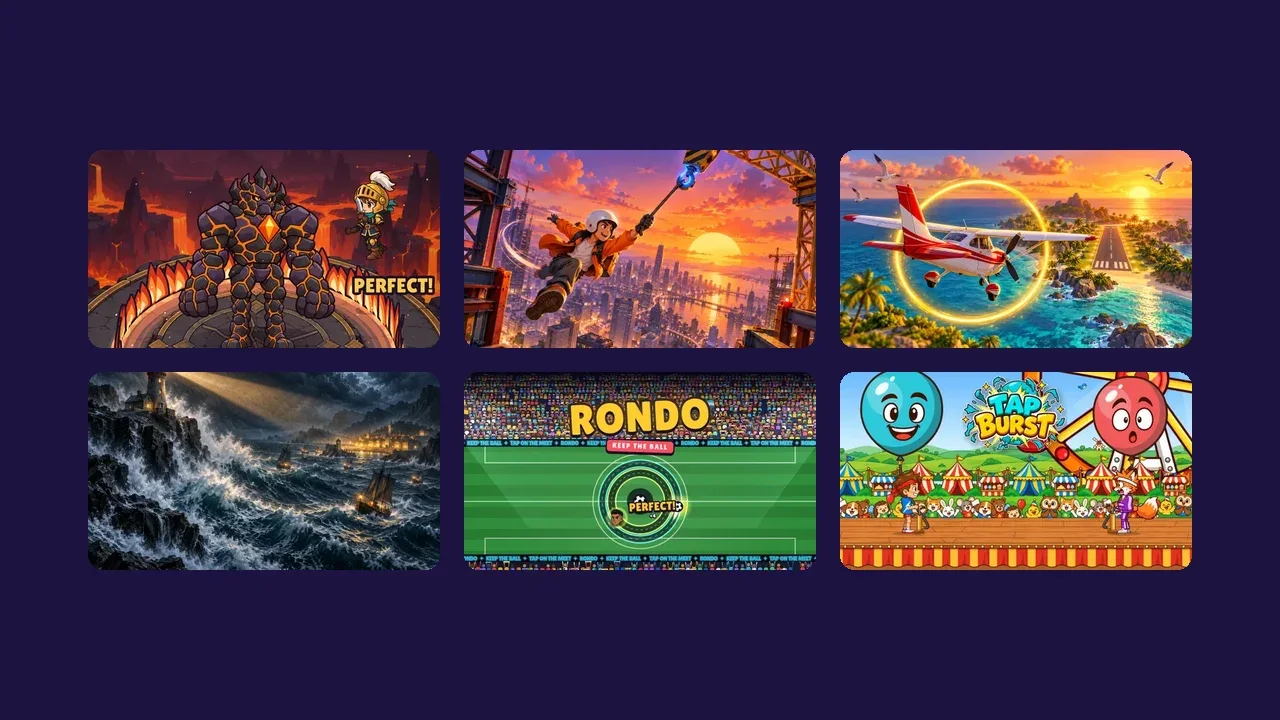
Six games on SalutGames are played with one input, which can be a tap, a click or the Space bar: One Tap Hero, Skyhook, Last-Second Landing, Lightkeeper, Rondo and Tap Burst. In Green's terms, five of them are about the timing of a single press: a jump, a release from a swing, a boost, a lamp signal, a touch on the ball. Tap Burst is the exception and has its own section below.
Three of the timing games grade a press as perfect inside a window that can be converted into milliseconds. The chart shows the full width of each window, from the earliest perfect press to the latest.
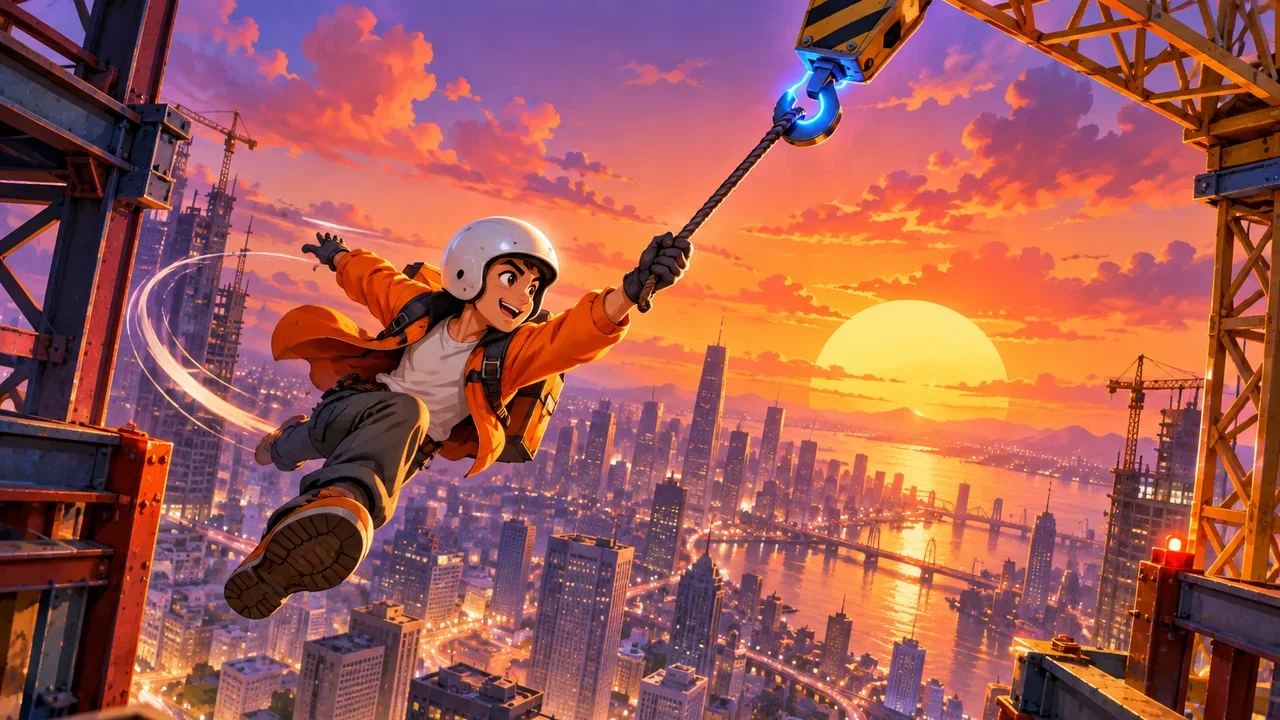
Each game stores its window in a different unit. Skyhook measures it as an angle of the swing. On the first mission a release is perfect within 0.36 radians either side of the sweet spot while the swing turns at 2.35 radians a second, and by the twelfth mission that becomes 0.25 radians at 3.2 a second. Last-Second Landing measures it as a share of the timing ring's cycle: 10.8% either side on a 1.6-second cycle at the start, 6.8% on a 1.05-second cycle by the ninth mission. Those figures are for the starting plane. Two unlockable planes widen the window, by 8% and 22%, and one narrows it by 14%. Rondo works in milliseconds directly, ±58 ms when a match starts, narrowing to ±46 ms over the first 30 touches.
A screen running at 60 frames per second shows a new frame every 16.7 ms. Rondo's tightest perfect window is therefore about five and a half frames wide, and Last-Second Landing's opening one about 21.
Rondo also allows for the delay between a finger touching the glass and the game receiving the tap. Every tap is judged as if it landed 40 ms before its event arrived, so a press that looks right on screen isn't pushed toward late.
Lightkeeper's window can't be reduced to one number. Its beam eases into each turn like a rotating lighthouse lens, so the same window lasts longer for a ship near the edge of the sweep than for one in the middle. Across the seven nights the window narrows from 0.1 to 0.066 radians, about a third.
Skyhook, below, starts on its 306 ms mission:
Tap Burst: the other kind of one-button game
Green's list also covers pressing again and again, and Tap Burst is built entirely on that. Every tap pumps air into the player's balloon, with the aim of popping the rival's. Each of the 18 rivals has a base pace, from 3.6 taps a second for Shelby the Turtle up to 7.8 for Chomp the Shark, and the bosses speed up halfway through a race.
The free speed test ranks a player against those rivals: the result is the fastest rival whose pace was matched. Below Shelby's 3.6 the rank is "Slower than Shelby", and ten taps a second or more earns "Faster than Lightning".
Sources
- Barrie Ellis, A Brief History of Video Game Accessibility: The 1970's, OneSwitch.org.uk, May 2009
- Steeplechase (video game), Wikipedia
- Berbank Green, One Button Games, Gamasutra, 2 June 2005
- GDC 10: Falling to your death, the Canabalt postmortem, Destructoid
- Canabalt and Flappy Bird, Wikipedia
- IGDA Game Accessibility SIG, Improved switch accessibility on mobile devices
- Timing figures for the SalutGames games: read from each game's source code, October 2026