Landing Games: Why a Safe Touchdown Feels So Good

In the autumn of 1969, Jim Storer, a student at Lexington High School, wrote a game for a PDP-8 minicomputer in a language called FOCAL. There were no graphics. Each turn stood for ten seconds of descent toward the Moon, and the only decision was how much thrust to burn, with an eye on speed and fuel. Land too fast and the lander crashed. Run out of fuel and it crashed anyway.
That text game spread through newsletters and books. David Ahl's BASIC version appeared in 101 BASIC Computer Games, which sold over 10,000 copies, and Ahl later called it "by far and away the single most popular computer game" of its time. The idea it started, a whole game spent preparing for one gentle moment at the end, is still around.
What Atari added in 1979
Atari's Lunar Lander arcade cabinet arrived in August 1979, ten years after the first crewed Moon landing, with vector graphics and a thrust handle that fired harder the harder it was pulled. Its rules settled three ideas that landing games have used ever since:
- A speed limit. Coming down too fast, or tilted too far, was a crash.
- Smaller targets are worth more. Landing pads flashed a bonus multiplier, and the smaller the pad, the higher it went.
- A good landing pays for the next one. A gentle touchdown handed back a little fuel.
The same three ideas in Last-Second Landing
| Idea | 1979 | Today |
|---|---|---|
| Speed limit | Too fast is a crash | Over 186 units of sink is a hard landing |
| Smaller target | Small pads, bigger multiplier | Touching down inside the zone |
| Landing pays | A little fuel back | 16% of the tank, up to 36% for a greased landing |
In the table, 1979 is Atari's Lunar Lander and today is Last-Second Landing. The last row belongs to Endless mode, where the runway is a checkpoint rather than a finish. Any safe landing refuels 16% of the tank, landing inside the touchdown zone adds 10%, and a greased landing adds another 10%. Scrappy landings barely top the tank up, so in Endless the quality of each landing decides how long the run lasts.
Three verdicts and a warning
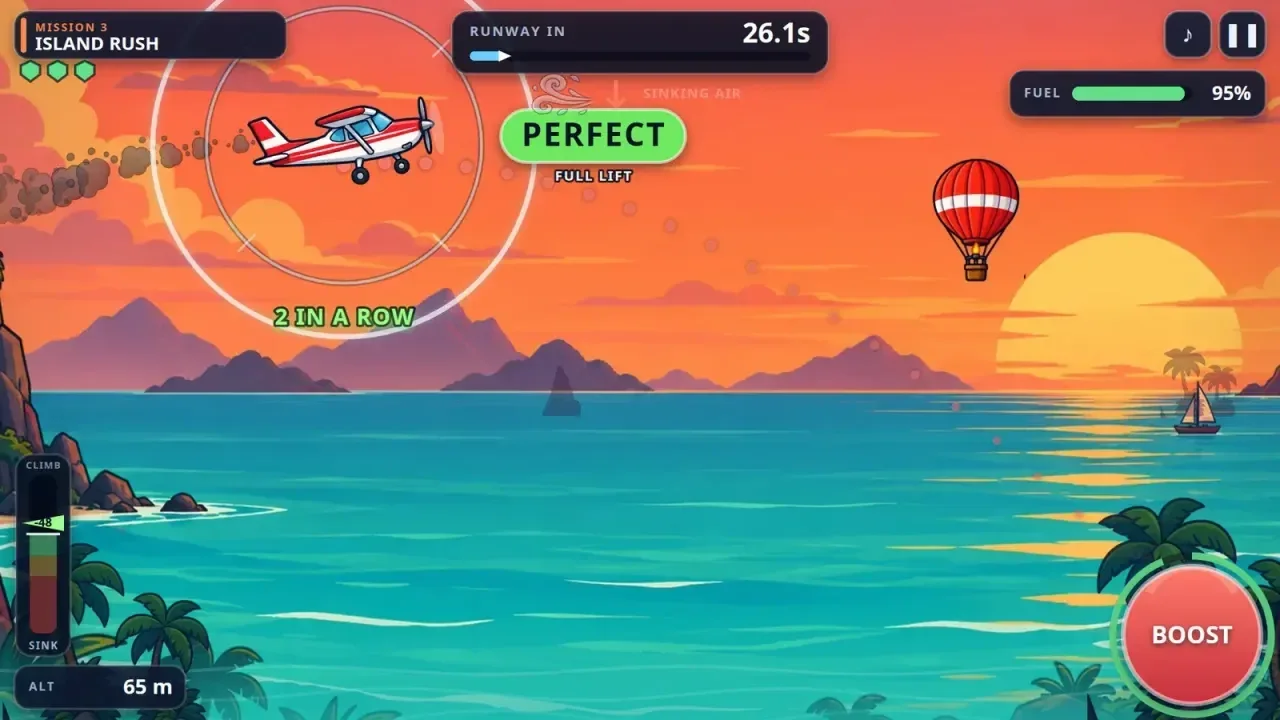
Every safe landing in Last-Second Landing gets a verdict, shown over the plane the moment the wheels touch:
- "GREASED IT": inside the zone, and sinking at 96 units or less.
- "ON THE NUMBERS": inside the zone, but firmer.
- "DOWN SAFE": on the runway, outside the zone.
A touchdown above the sink limit isn't a landing at all. The flight ends with "HARD LANDING" and a short instruction: "Flare sooner."
How much the last second is worth
On a campaign mission, a large share of the final score is decided at touchdown. Accuracy, meaning how close to the middle of the zone the wheels touch, is worth up to 420 points. Softness is worth up to 260 more. That's 680 points from a single moment, against 60 to 160 for each perfect boost on the way down. A flight that never lands keeps only 35% of the points it built in the air.
That weighting follows the genre's oldest idea. The flight is preparation, and much of the judgement lands in the last second.
Getting it right
The same habits work in 1979 and today. Keep some altitude in reserve instead of spending fuel early. Stop climbing near the runway and let the plane settle, because a boost close to the ground adds lift exactly when the plane should be coming down. Aim for the zone first and the softness second, since accuracy is worth the larger share of the score.

Sources
- Lunar Lander (video game genre), Wikipedia
- Lunar Lander (1979 video game), Wikipedia
- SalutGames: Last-Second Landing's source code