
Last-Second Landing Guide: Why Tapping Less Gets You Further


Last-Second Landing starts every mission with a dead engine and a runway that is still a long way off. There is no steering and no throttle. The only control is a boost, and a timing ring closes around the plane on every beat to say when that boost is worth taking.
Most first flights go down for the same reason: too many taps. The game's own numbers show why.
What each kind of tap costs
Every boost is graded the moment the tap arrives. Fuel is shown as a percentage of the tank, and each grade has a fixed price in every plane:
| Boost | Lift | Fuel used |
|---|---|---|
| Perfect | 268 | 1.6% |
| Good | 196 | 3.2% |
| Weak | 112 | 5.5% |
A perfect boost lifts eight times more per drop of fuel than a weak one. On top of that, every fifth perfect in an unbroken chain hands back 5% of the tank. Five perfects in a row cost 8% and earn 5% back, a net 3%. Five weak taps cost 27.5%.
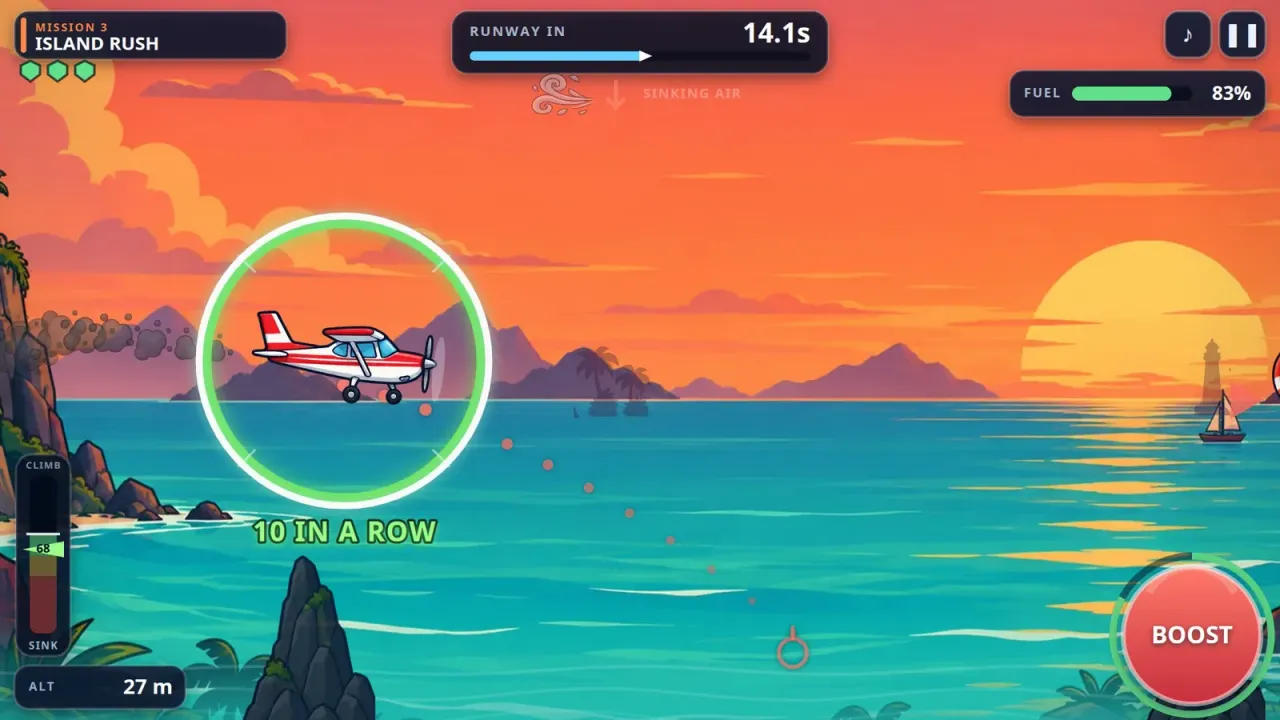
The verdicts say which way a tap missed. A good boost comes with "a touch early" or "a touch late", and a weak one with "too early, wait for the ring" or "too late, tap as it lands". Perfects also score more as the chain grows, from 60 points for the first to 160 from the sixth in a row.
Getting down in one piece
The hull takes three hits before the flight is over. A landing counts once the wheels are a short distance past the runway threshold, not when the nose first crosses it, and sinking too fast at touchdown ends the run with the message "Flare sooner." The fix is to stop climbing near the runway and let the plane settle.
The nine missions
| Mission | Objective | Fuel star |
|---|---|---|
| First Flight | Chain 3 perfect boosts | 50% |
| Bird Passage | Take no damage | 46% |
| Island Rush | Touch down inside the zone | 44% |
| Harbor Storm | Chain 4 perfect boosts | 42% |
| City Rescue | Take no damage | 40% |
| Lightning Run | Touch down inside the zone | 38% |
| Frozen Valley | Chain 5 perfect boosts | 40% |
| Ice Corridor | Take no damage | 38% |
| Final Approach | Touch down inside the zone | 36% |
Each mission awards one star for landing, one for landing with at least the listed fuel left, and one for its objective. The three worlds each repeat the same pattern, a streak, a clean flight and a precise touchdown, and the streak target grows by one per world.
The Coral Islands begin with the reef on First Flight, a gull colony crossing the approach on Bird Passage, and a crosswind off the cliffs on Island Rush. The Thunder Coast brings a rain squall with rescue traffic in the lane, drifting lightning cells on City Rescue, and downdraft swirls on Lightning Run. The Glacier Range adds icing and spires on Frozen Valley, survey cables strung across the valley on Ice Corridor, and finally "last tank, last strip" on Final Approach.
From First Flight to Final Approach the beat shortens from 1.6 to 1.05 seconds, and the perfect window shrinks from 346 to 143 milliseconds.
Five planes
| Plane | Stars | Lift | Drain | Window |
|---|---|---|---|---|
| Red Scout | 0 | normal | normal | normal |
| Gold Bush | 6 | +12% | +9% | normal |
| Blue Rescue | 12 | −4% | −15% | +8% |
| Orange Hauler | 18 | −10% | −9% | +22% |
| Silver Dart | 24 | +24% | +4% | −14% |
One detail is easy to miss: a plane's fuel rating only changes the steady drain during flight. A boost costs the same 1.6%, 3.2% or 5.5% in every plane. In the table, drain means that steady fuel use, and window means the perfect timing window. The timing rating also widens how hard a landing can be before it counts as a crash, which is why the Orange Hauler is so hard to upset. For the fuel star, the Blue Rescue is the obvious pick: the slowest drain and a wider window than the starting plane.
Endless mode
In Endless the runway is a checkpoint rather than a finish. Each landing refuels the plane and sends it into a harder leg, generated by a formula instead of designed by hand.
Every leg narrows the window by 2.2% and shortens the beat by 2.8%. The beat stops getting faster at leg 23, and the window reaches its floor at leg 34. Hazards climb to their maximum of eight by leg 13.
Fuel comes from landing well. Any safe landing returns 16% of the tank, touching down inside the zone adds 10%, and a smooth, greased landing adds another 10%. Scrappy landings barely top the tank up, which is what ends most runs a few legs later. Every fourth leg also repairs one point of hull.