How to Play Dots and Boxes: Rules and Winning Strategy


Dots and Boxes is a pencil-and-paper game for two players. You start with a grid of dots. Players take turns drawing one line between two dots that are next to each other, across or down. If your line closes the fourth side of a box, you win that box, write your initial in it, and must draw another line. When every line has been drawn, the player with the most boxes wins.
The rules take a minute to learn. Winning takes a little more: the game is decided by chains, and most players never notice them. This guide covers the rules first, then the strategy, from beginner to strong.
The rules
- Draw a grid of dots. 4 × 4 dots (3 × 3 boxes) is a good first board. 6 × 6 dots (5 × 5 boxes) is the classic size for a real game.
- Take turns drawing one line between two neighbouring dots, across or down. No diagonals.
- Close a box, claim it. If your line completes the fourth side of one or two boxes, write your initial in them.
- Then go again. Closing a box gives you another line. You keep going as long as you close boxes.
- The game ends when the grid is full. Count the boxes: the most boxes wins.
Some families play that closing a box is optional, or that you don't get an extra turn. The strategy below is for the standard rules, where you must move again after closing a box.
A short history
The game was first described in 1889 by the French mathematician Édouard Lucas, who called it la pipopipette. Since then it has been played on the back of countless school notebooks, and in 2000 the mathematician Elwyn Berlekamp wrote a whole book about its strategy, The Dots-and-Boxes Game: Sophisticated Child's Play. Most of the ideas below come from it.
Beginner strategy: never draw the third side
A box with three sides drawn is a gift: your opponent closes it on their next line. So at the start:
- Don't draw the third side of any box if you have another choice.
- Draw lines on the edges and in open areas where they don't complete anything.
- Take every free box your opponent leaves you, unless you're using the trick below.
If both players do this, the board fills up until every remaining move gives away boxes. That moment decides the game.
The key idea: chains
When the safe lines run out, the board has split into chains: rows of boxes connected so that one line into the chain lets the other player take the whole row, box after box.
- A short chain has 1 or 2 boxes.
- A long chain has 3 or more boxes.
- A loop is a chain that closes on itself, like a ring of boxes.
Now each player must open a chain for the other. You'll want to give away the shortest chains first and make your opponent open the long ones.
The double-cross trick (all but two)
This is the move that separates strong players from everyone else.
Say your opponent opens a long chain of 5 boxes. The obvious move is to take all 5. But then you have to draw another line, and that line opens the next chain for them.
Instead, take all but the last two boxes, then draw the line at the far end of the chain that leaves those two boxes as a domino with one line missing between them. Your opponent takes both boxes with one line (a double-cross), and then they have to open the next chain for you.
You gave away 2 boxes to keep control. With several long chains left, that is worth far more than 2 boxes. In a loop, the same trick costs 4 boxes instead of 2.
The player who keeps control usually wins: they take most of every long chain and give away only two boxes from each, except the last one, which they take whole.
The long chain rule: who gets control
Control goes to the player who gets the number of long chains right. Berlekamp's long chain rule:
The first player should try to make the number of dots plus the number of long chains even. The second player wants it odd.
In practice, on the usual boards:
| Board | Dots | First player wants | Second player wants |
|---|---|---|---|
| 3 × 3 boxes | 16 | an even number of long chains | an odd number |
| 4 × 4 boxes | 25 | an odd number | an even number |
| 5 × 5 boxes | 36 | an even number | an odd number |
Loops don't count as long chains in this rule. During the middle game, strong players try to join two chains into one, split one into two, or make a chain too short to count, so that the final number suits them. To fix the count, it's often worth giving away a box or two early.
A simple plan for your next game
- Opening: draw safe lines and never the third side of a box.
- Middle game: count the chains that are forming. Is the number of long chains good for you? If not, try to merge two, split one, or shorten one.
- Endgame: give away short chains first. When you take a long chain that isn't the last one, keep the last two boxes back with the double-cross trick.
- Last chain: take every box.
Play Dots and Boxes online
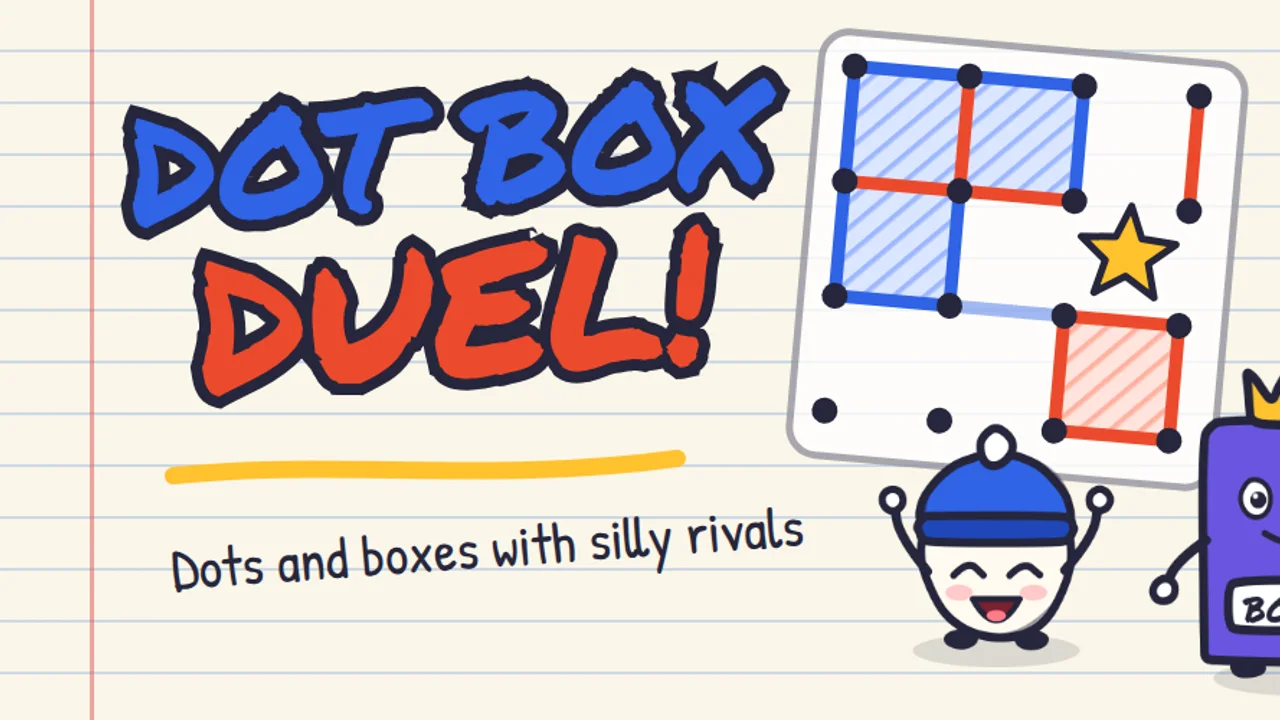
Dot Box Duel is a free dots and boxes game on SalutGames that runs in your browser, on a Chromebook, a PC or a phone. You tap or click between two dots to draw a line, close a box to claim it and draw again, and the player with more boxes wins.
It adds two special boxes that change the maths above: star boxes are worth 2 points, and bomb boxes score but end your turn, so a chain with a bomb in it can't be swept in one go. You can climb the Duel Ladder against eight notebook rivals, play a Quick Duel against the computer, or play Pass & Play with a friend on the same device. Each duel gives you three hints. The Dot Box Duel guide covers the rivals and modes.
Questions
Who goes first in Dots and Boxes?
Any way you like: a coin toss, or the youngest player. Going first doesn't win the game by itself. Knowing which number of long chains you need, and steering the board towards it, matters much more.
Do you get another turn when you make a box?
Yes, in the standard rules. Closing a box means you must draw another line.
What is a good board size?
4 × 4 dots (3 × 3 boxes) to learn, and 6 × 6 dots (5 × 5 boxes) for a full game. Bigger boards make the chain battle longer.
What is the trick to winning Dots and Boxes?
Don't draw the third side of a box, count the long chains, and when you take a long chain, leave the last two boxes to your opponent so they have to open the next chain for you.
Can you play Dots and Boxes with more than two players?
Yes, the rules work the same, but the chain strategy is much harder to plan with three or more players.