Dot Box Duel Guide: Beating All Eight Rivals

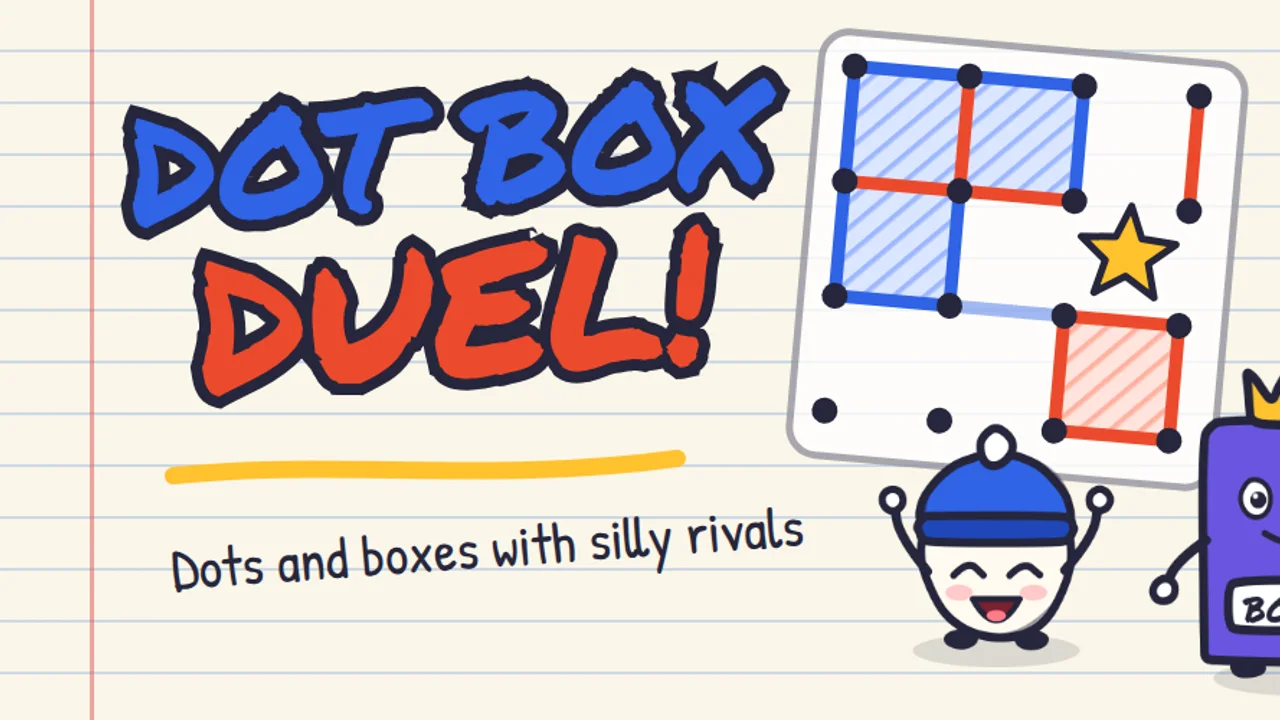
Dots and Boxes looks like a game of luck played in the margins of a notebook. It isn't. The rules fit in a sentence: players take turns drawing one line between neighbouring dots, and whoever draws the fourth side of a box claims it and draws again. But underneath there is a well-studied strategy, laid out by the mathematician Elwyn Berlekamp in a whole book on the game, and Dot Box Duel's rivals are built on it.
The eight rivals
The Duel Ladder runs through four chapters of six duels each, with a boss at the end of every chapter.
| Rival | Plays | Note |
|---|---|---|
| Eddie Eraser | easy, then medium | "Rubs out mistakes. Makes plenty." |
| Stella Sticky | easy, then hard | "Sticks to a plan. Sometimes." |
| Professor Pencil | medium, then hard | Boss of the Pencil Case |
| Clip | medium, then hard | "Nervous. Very bendy." |
| Mugsy | medium, then hard | Boss of the Homework Desk |
| Miss Rula | medium, then hard | Boss of Art Class |
| Scissor Sam | medium, then hard | "Cuts corners. And chains." |
| The Big Binder | hard | Boss of the Principal's Office |
The three difficulty levels are described in the game's code, and they double as a lesson plan. An easy rival usually grabs a free box and otherwise draws almost any line, sometimes a bad one. A medium rival takes every box on offer, never draws the third side of a box while a safe line exists, and when forced to give boxes away, gives the fewest. A hard rival does all that and plays the endgame properly, which is where the real game is.
Safe lines, then chains
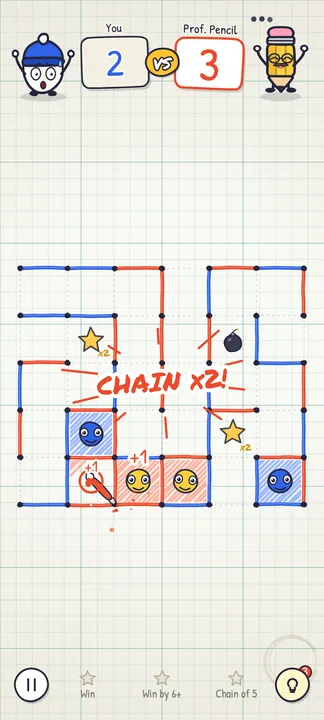
Early on, the game is a race of safe moves: lines that don't create a box with three sides. Sooner or later the safe lines run out, and someone has to open a chain, a row of boxes the other player can then take one after another. As Wikipedia's summary of the game puts it, the player who first opens a long chain usually loses.
A hard rival plays for exactly that. During the safe phase it looks ahead so the player runs out of safe lines first.
The double-cross
The strongest idea in the game is the double-cross. Instead of taking every box in a chain, a player takes all but the last two, then draws the line that hands those two back. The opponent gets two boxes but has to move again, and so has to open the next chain. Played through the whole endgame, that means taking all but two boxes of each chain and everything in the last one.
Hard rivals in Dot Box Duel use it. They also defend against it: when they have to open a chain of exactly two boxes, they open it with what Berlekamp called a hard-hearted handout, drawing the line that leaves no way to decline the boxes and double-cross back.
Stars, stars and bombs
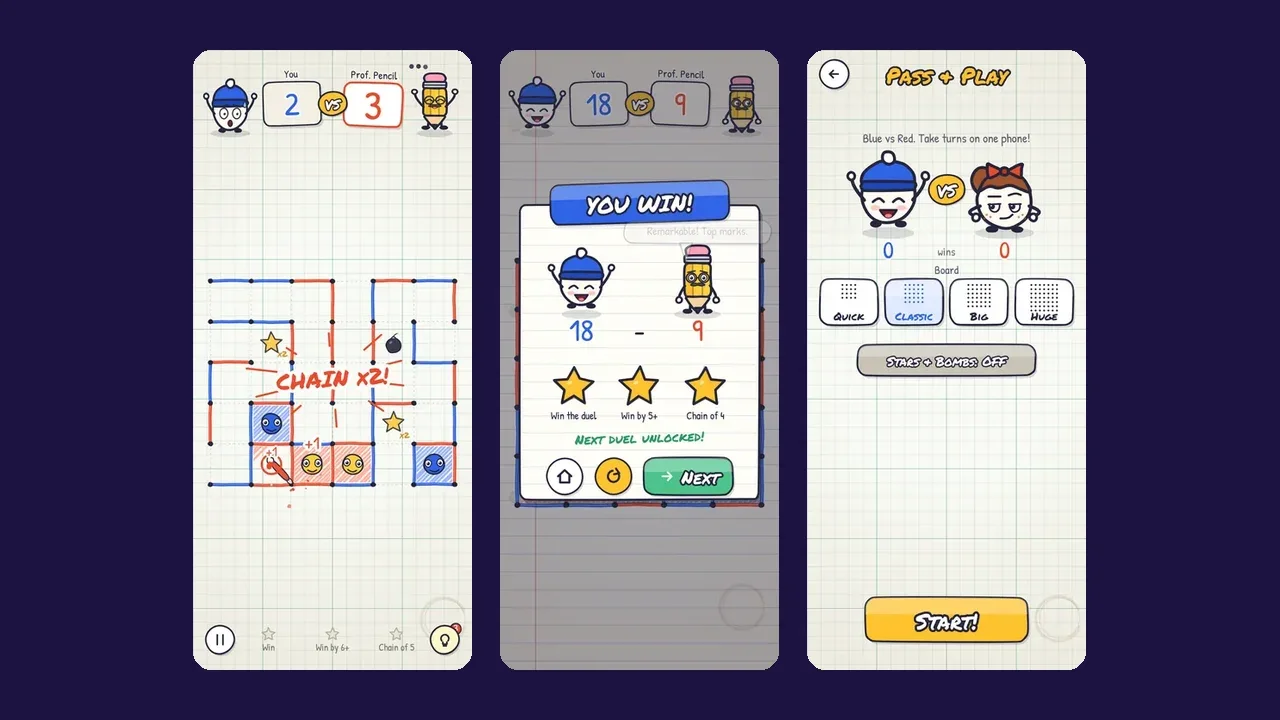
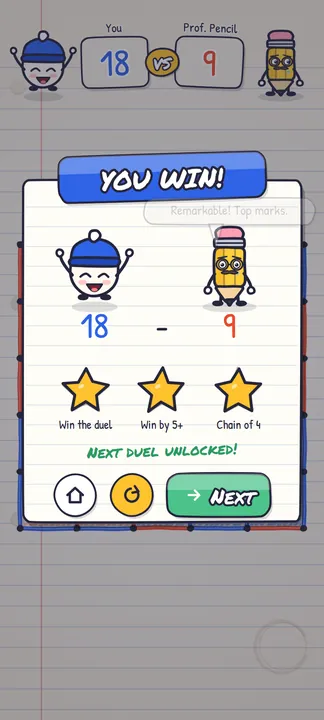
Each duel awards a star for winning, a star for winning by a set margin, and a star for claiming a set number of boxes in a single turn. The targets grow through the ladder, up to a margin of 6 and a chain of 6.
From the first chapter on, some boards add their own rules. A star box is worth two points. A bomb box, from the Homework Desk on, ends the turn of whoever closes it, which breaks the usual "close a box, draw again" rhythm. Some boards have holes, and some start with a few lines already drawn in grey ink.
Pass and Play
The same game works for two people on one phone, blue against red, in four board sizes from Quick to Huge, with stars and bombs switched on or off. It's the simplest way to try a double-cross on a friend.
Sources
- Dots and boxes, Wikipedia, citing Elwyn Berlekamp, The Dots-and-Boxes Game: Sophisticated Child's Play (2000)
- SalutGames: Dot Box Duel's source code