
Gravibot Guide: All 7 Sectors, and How to Get 3 Stars


Gravibot has no jump button. The robot walks left and right, and the only other thing it can do is flip gravity, so the ceiling becomes the floor and a fall becomes a climb. The game stretches that single rule across 28 rooms in seven sectors, and each room opens with a one-line tip that names the idea it is testing.
The two numbers that make flips forgiving
Flipping is only allowed while the robot stands on something, with two exceptions built into the physics. After walking off an edge there are still 85 milliseconds to flip, and a flip pressed up to 130 milliseconds before touching down is stored and fires on landing. Neither shows up anywhere on screen. Together they are what make it possible to chain flips without stopping on every surface.
The exit stays sealed until every energy core in the room has been collected. R restarts instantly. A restart counts as a reboot, though, and reboots cost the flawless star.
Sector by sector
| Sector | Rooms | What it adds |
|---|---|---|
| Docking Ring | 1 to 4 | The void, platforms, pulsing lasers |
| Reactor Spine | 5 to 8 | Lifts, boost pads, flux lines |
| Core Chamber | 9 to 12 | Crates, darkness |
| Cargo Bay | 13 to 16 | Conveyors, pressure plates |
| Warp Lab | 17 to 20 | Warp gates |
| Orbital Deck | 21 to 24 | Flip orbs, flips in mid-air |
| Heart of the Station | 25 to 28 | Forced flips, crumbling floors, an escape timer |
Docking Ring. Room 2's tip is the first real lesson: the void is bottomless, so it gets crossed overhead. Lasers in room 4 pulse, and the tip says to move when they go dark. Watching one full cycle before stepping in is cheaper than a reboot.
Reactor Spine. Boost pads throw the robot away from whatever surface they sit on, so a pad on the ceiling throws it down. Flux lines flip gravity on contact, which makes them free flips that can't be refused. In room 8, Crossfire, the tip is to cling to the lift and cross between pulses.
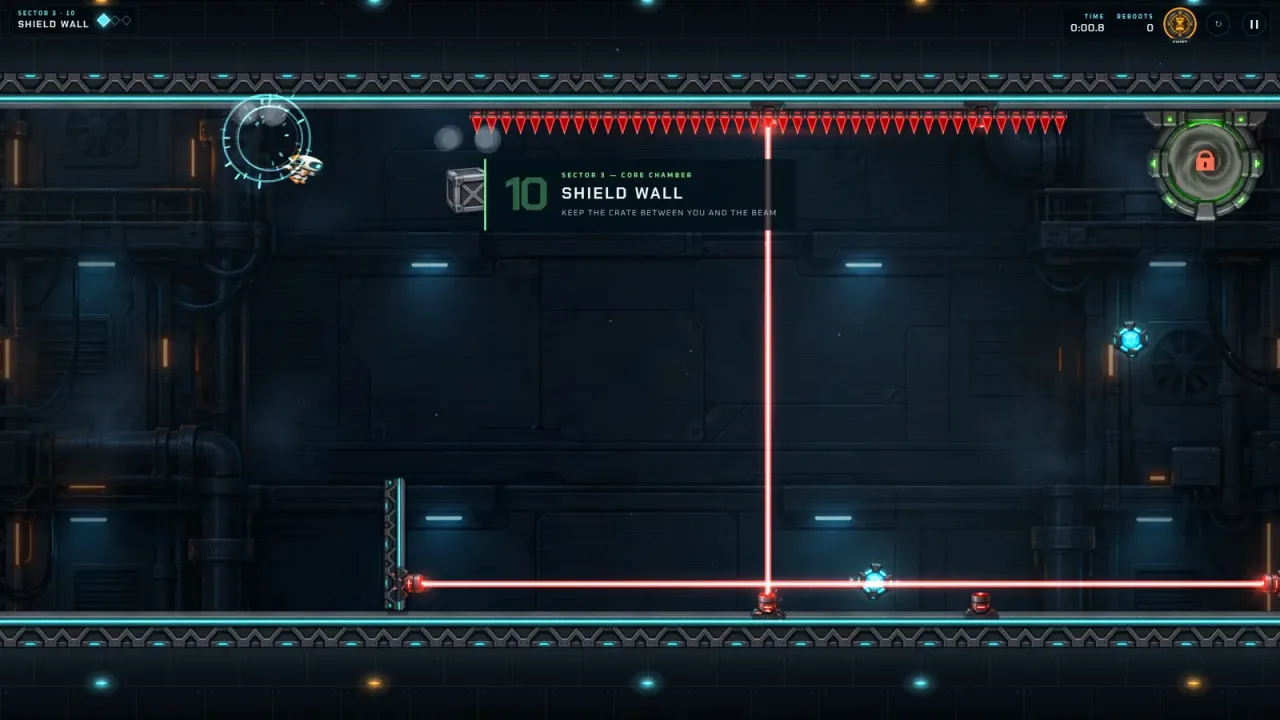
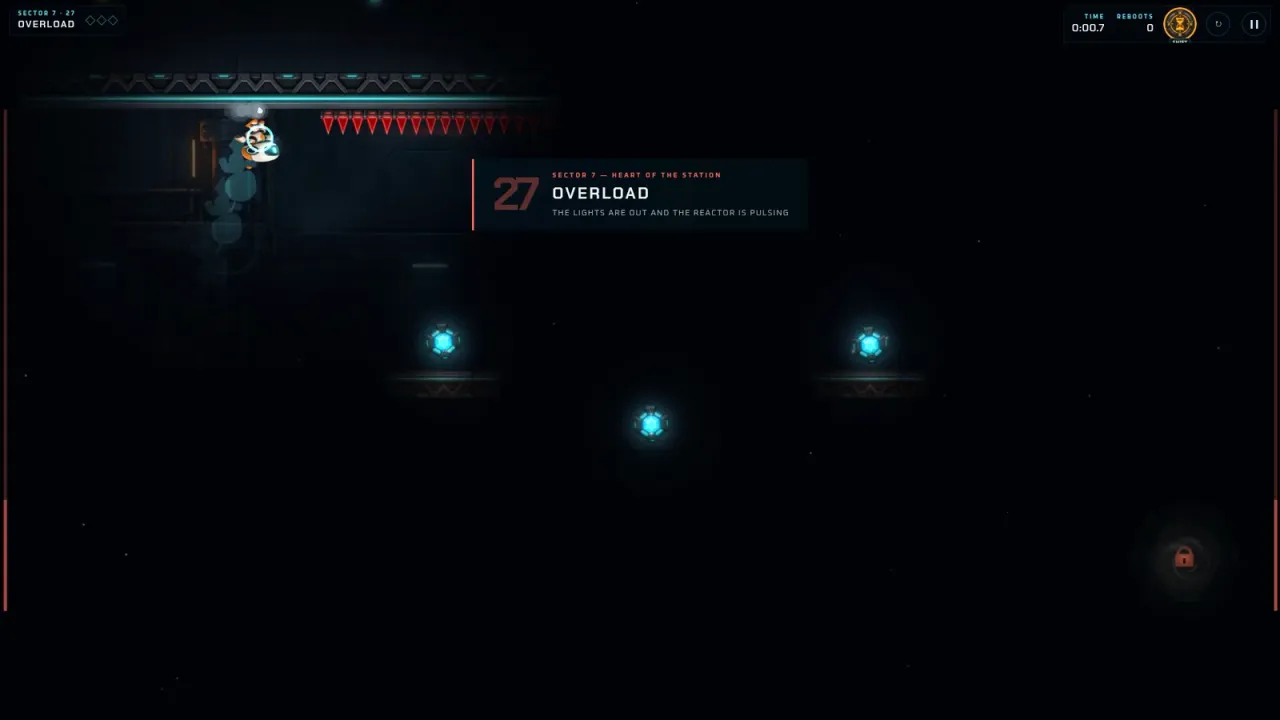
Core Chamber. Crates obey gravity like everything else and they block laser beams. Room 10, Shield Wall, is solved by walking with a crate between the robot and the beam. Room 11 cuts the power, and only the visor lights the way. Room 12, Zero Down, still carries the tip "everything you learned, one last run": the first full build of the game had 12 rooms, and this was where it ended.
Cargo Bay. The ceiling conveyor runs the opposite way to the floor belt, so a flip also changes direction. Pressure plates only hold doors open while something stays on them, and every flip moves the crates as well, plates or not. Room 16's tip sums it up: every flip moves the cargo too, so let it ride.
Warp Lab. Gates come in pairs, in through one and out of its twin. Room 18, Relay, makes the important point: a gate keeps the robot's speed, so the way through is often to enter a gate halfway through a fall. Room 20, Paradox, adds the twist that crates can warp too.
Orbital Deck. Flip orbs break the rule the first twenty rooms taught. Grabbing one in mid-air allows another flip before landing. Room 23 mixes them with flux lines, which flip the robot one way while the orbs flip it back. Room 24 has no floor and no ceiling at all.
Heart of the Station. The last sector takes control away. In room 25, Pulse, the reactor flips gravity on its own rhythm and the robot can only steer. Room 26 adds floors that give way, room 27 is a pulse room with the lights out, and room 28 is the escape, with a timer running out before the pod.
Three stars, and where the par times come from
Each room awards one star for clearing it, one for beating its par time, and one for a flawless run, meaning no reboot and no use of the chrono brake.
Par times are not guesses. The game's solver plays every room by itself and records the time of its route, and par is that time doubled plus four seconds, rounded up. The solver's fastest routes add up to 137.8 seconds for all 28 rooms. Par for the same rooms adds up to 403 seconds, just under seven minutes.
The Orbital Deck has some of the shortest pars in the game, which says nothing about difficulty: its rooms are quick once the orb chain is known. The single longest par belongs to room 25, Pulse, at 25 seconds, the room where the reactor decides when gravity flips. Room 5, Lift Off, is next at 18 seconds, on a route that rides the lifts across the void.
The method that works is three passes. Clear a room once by any means, replay it for the par time, then once more for the flawless run.
The chrono brake and the ghost
Holding Shift or C slows the whole world to 40% speed. The brake holds two seconds of energy and recharges after a short pause, and using it at all marks the run as not flawless.
At the third reboot in a room, a message points to the ghost guide in the pause menu. Switched on, it replays the solver's route in step with the current attempt, under the message "Follow the echo". Reboots keep counting until the room is started again from the map or the results screen, so a flawless run needs that fresh start.
The robot walks with A and D or the arrow keys and flips with Space, W, S, the up or down arrow, J or K. R restarts, Esc or P pauses, and a gamepad works too. On phones the controls sit on a deck under the room rather than on top of it.