What Is Pétanque? Rules, How to Play and Pétanque vs Bocce
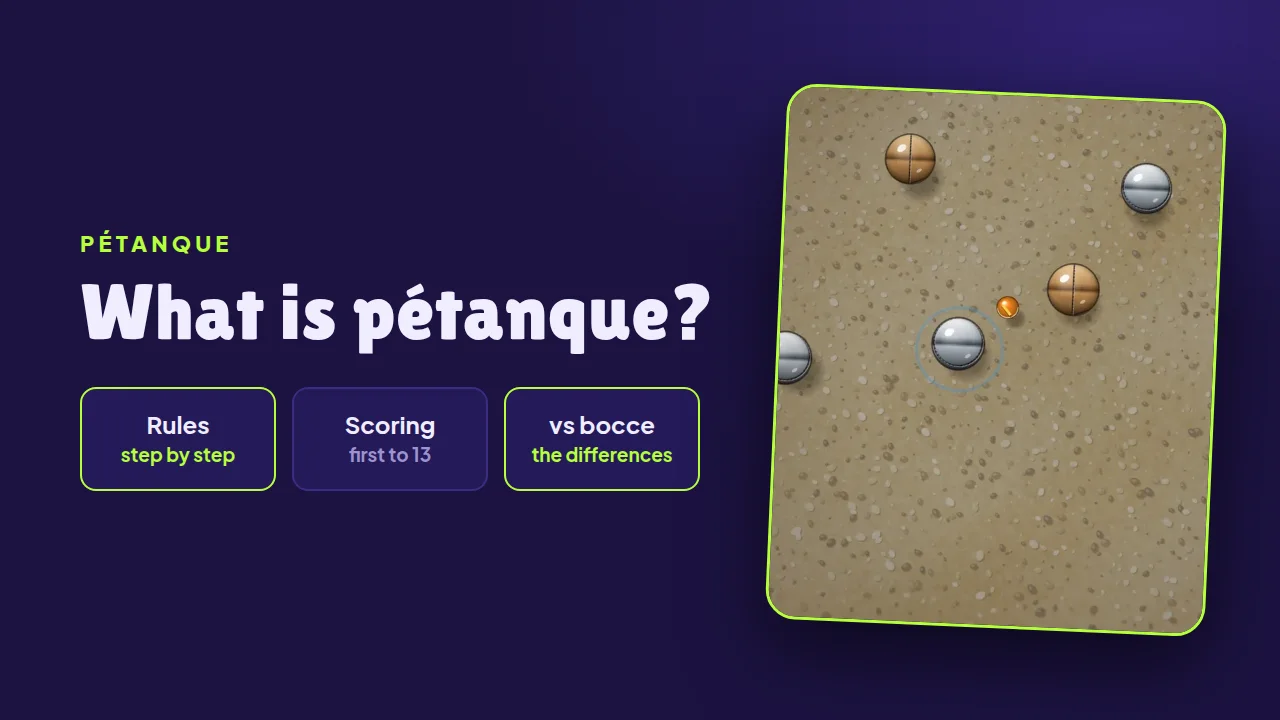
Pétanque is a French boules game in which two teams throw hollow steel balls, called boules, as close as possible to a small wooden ball, called the jack. Players throw from a small circle with both feet on the ground, and after each round the team with the closest boule scores one point for every boule nearer to the jack than the other team's best one. The first team to 13 points wins.
It's played on almost any hard ground, gravel is the classic, and it needs no court, no lines and no special shoes. That's why you see it in village squares across France, on beaches and in parks all over the world.
Pétanque in 30 seconds
| Players | 1 v 1, 2 v 2 or 3 v 3 |
| Boules per player | 3 (singles and doubles), 2 (triples) |
| The jack | a small ball about 3 cm across, thrown 6 to 10 m away |
| Where you stand | inside a circle 35 to 50 cm wide, feet together on the ground |
| One round (an "end") | every boule is thrown, then the points are counted |
| Winning score | 13 points |
| Ground | gravel, packed earth, sand, grass: almost anything |
Where the name comes from
Pétanque was born in La Ciotat, near Marseille, in 1907. The older southern French game, jeu provençal, has players take a run-up of three steps before throwing at a jack up to 20 metres away. A player named Jules Lenoir had rheumatism and could no longer run, so the game was shortened and played from a standing position. The name comes from the Provençal words pè tancat, "feet planted" (pieds tanqués in French).
The first official tournament was held in La Ciotat in 1910, and the international federation, the FIPJP, was founded in Marseille in 1958.
What you need
- Boules. Competition boules are steel, 7.05 to 8 cm across and weigh 650 to 800 g. Each player has their own set, usually with a pattern of grooves so you can tell them apart.
- A jack (le cochonnet, "the piglet", or le but). A small wooden or synthetic ball about 3 cm across.
- A circle. Draw one in the gravel with your heel or a stick, 35 to 50 cm wide, or use a plastic ring.
- A tape measure. For the close calls, and there are always close calls.
How to play pétanque, step by step
- Toss a coin. The winning team draws the circle and throws the jack 6 to 10 metres away.
- The same team throws the first boule, trying to land it as close to the jack as possible.
- The other team throws next and keeps throwing until one of its boules is closer than the best boule of the first team, or until it runs out of boules.
- Whoever is not closest throws next. This is the key rule: the team that is "holding the point" waits, and the team that is behind keeps throwing.
- When one team has no boules left, the other team throws its remaining boules to add more points.
- Count the points. The team with the closest boule scores one point for each of its boules that is nearer to the jack than the other team's best boule.
- Start the next end. The team that scored draws a new circle around the jack's last spot and throws the jack again.
Throwing feet: both feet stay inside the circle and touch the ground until your boule lands. Most players throw with the palm facing down, which puts backspin on the boule and helps it stop where it lands.
How scoring works (with an example)
Only one team scores in each end. Say your team has boules at 10 cm, 25 cm and 60 cm from the jack, and the other team's best boule is at 40 cm. Your 10 cm and 25 cm boules are both nearer than 40 cm, so you score 2 points. Your 60 cm boule doesn't count.
If the closest boules of both teams are at exactly the same distance, no one scores that end (in official rules there are a few extra cases, but this is the simple version most friends play).
The throws: pointing and shooting
Every throw is either a point or a shot.
Pointing means placing your boule near the jack. There are three ways to do it:
- Roll (la roulette): the boule lands just in front of you and rolls all the way. Good on smooth, flat ground.
- Half-lob (la demi-portée): it lands about halfway and rolls the rest. The most common point.
- Lob (la portée or la plombée): it flies high and lands close to the jack with very little roll. Best on rough ground full of stones.
Shooting means throwing your boule straight at an opponent's boule to knock it away. The dream shot is the carreau: your boule hits theirs, sends it flying, and stops on the exact spot where it was.
In a team, players usually have roles: the pointer places boules, the shooter removes the other team's best ones, and in triples a middle player does both.
Pétanque vs bocce: the differences
Pétanque and bocce are cousins, and both are part of the wider family of boules games. Here's what sets them apart:
| Pétanque | Bocce | |
|---|---|---|
| From | France (Provence) | Italy |
| Balls | hollow steel, 7–8 cm, 650–800 g | solid composite or wood, larger and heavier (about 10–11 cm) |
| Throw | from a circle, feet still, usually palm down | from behind a line, often with a few steps, usually palm up and underhand |
| Court | any ground, no boards needed | a long, flat court, often with side boards |
| Target ball | jack (cochonnet) | pallino |
| Winning score | 13 | usually 12 or 13, depending on the rules used |
The quick way to tell them apart: if the balls are shiny metal and the players stand in a little circle, it's pétanque.
Words you'll hear on a pétanque court
- Mène: an end, one round.
- Cochonnet: the jack.
- Tête-à-tête, doublette, triplette: singles, doubles, triples.
- Pointer / tirer: to point / to shoot.
- Carreau: a perfect shot where your boule takes the other one's place.
- Fanny: losing 13–0. Tradition says the losers have to kiss a picture of a lady named Fanny.
Play pétanque in your browser
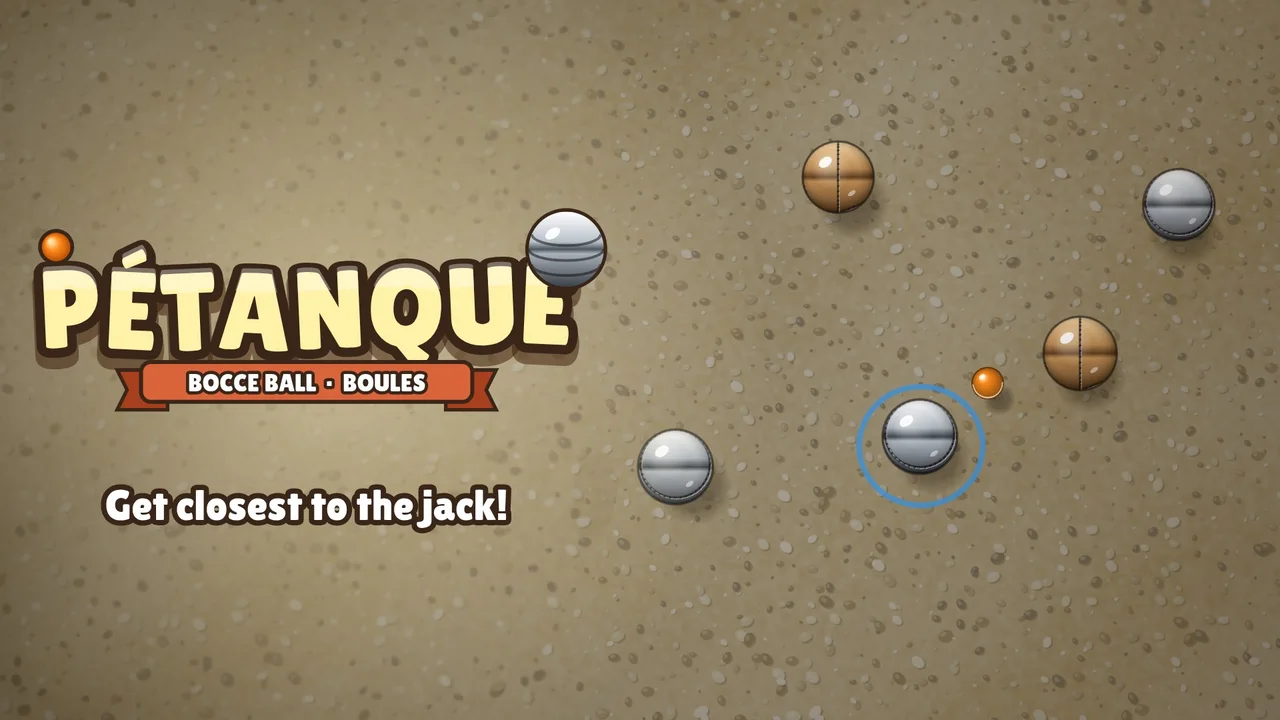
You don't need a set of boules to learn the feel of the game. Pétanque on SalutGames is a free boules game that runs in a browser tab, on a Chromebook, a PC or a phone, with no download.
It follows the same core rules: a coin toss decides who starts, the jack lands 6 to 10 metres away, you have three boules, and whoever is not closest throws next. You drag on the court to choose where your boule lands, pick a Roll, Half-lob, Lob or Shoot, then tap the power bar while the needle is in the green. One change keeps matches short: the first player to 7 points wins instead of 13.
You can beat 24 rivals on four courts, from a Provence village square to a Marrakech riad, or play a friend on the same screen.
Tips for your first games
- Point first, shoot later. Beginners win more ends by placing boules close than by trying to knock others away.
- Look at the ground before you throw. On stony ground, a lob is safer than a roll, because a rolling boule bounces off pebbles.
- Don't throw all your boules early. The team with boules left at the end has the last word.
- Aim for the spot, not the jack. Pick the place where your boule should land and let it roll from there.
Questions
Is pétanque the same as boules?
Pétanque is one kind of boules. "Boules" is the family name for games where you throw balls at a target ball, and it also includes jeu provençal, bocce and lawn bowls.
How many points do you need to win pétanque?
13 points in the official rules. Friendly games and many apps use shorter targets; our Pétanque game plays to 7.
How far do you throw the jack in pétanque?
Between 6 and 10 metres from the circle, for adults.
Can you play pétanque on grass?
Yes, though the boules roll less and bounce more on long grass. Packed gravel is the classic ground, and any fairly hard surface works.
What is the difference between pétanque and bocce?
Pétanque uses smaller steel balls thrown from a circle with both feet still, on any ground. Bocce uses larger composite balls, thrown from behind a line, usually on a prepared court with side boards.