Silent Maze Guide: Finding the Way Out by Sound

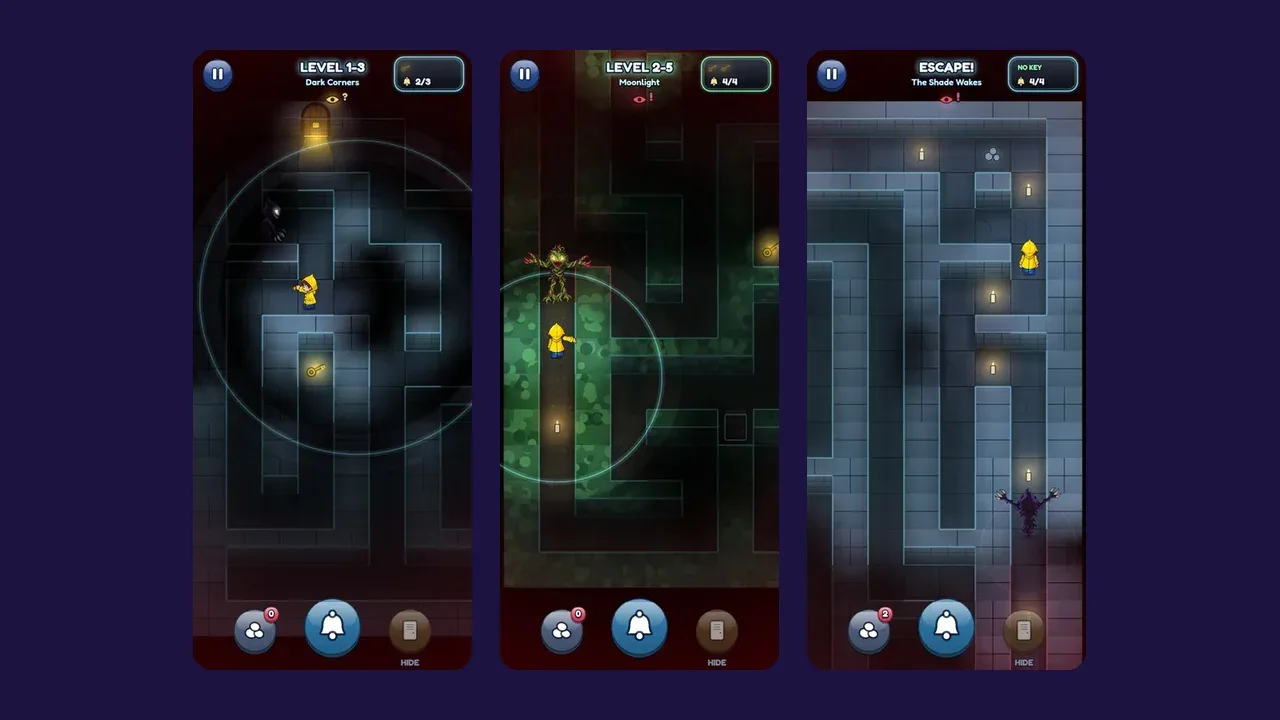
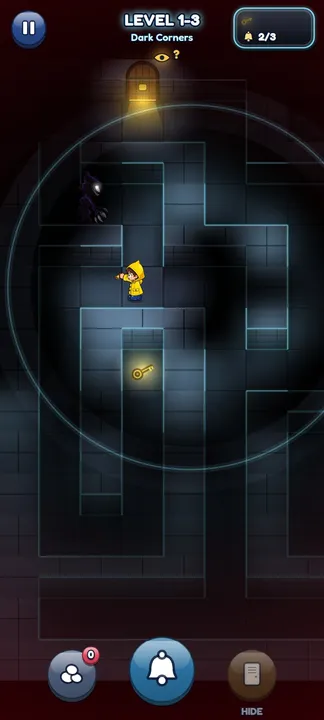
Every maze in Silent Maze starts in total darkness. The kid carries a brass bell, and ringing it sends out an echo that lights the nearby walls for a moment before they fade to a faint outline the game remembers. The catch is written into the code in two numbers. A ring lights the walls 7.5 cells away, but a creature with normal hearing picks it up from about 10 cells away. Every ring shows less of the maze than it gives away.
Every sound has a range
| Sound | Echo seen | Heard by a creature |
|---|---|---|
| Footstep | 1.3 cells | 1.6 cells |
| Creaky board | 3.2 cells | 6.7 cells |
| Puddle splash | 3.2 cells | 6.7 cells |
| Thrown pebble | 3.2 cells | 7.7 cells |
| Lever | 4.5 cells | 9.6 cells |
| Bell ring | 7.5 cells | 10.4 cells |
The heard column is each sound's loudness multiplied by 1.6, for a creature with normal hearing. Each creature's own hearing scales that figure further. Walking is nearly silent, which makes the bell the one sound that is entirely the player's choice.
The pebble is the exception that makes the rest work. It lands where it's thrown, not where the kid stands, and it carries almost eight cells. A pebble thrown down a side passage pulls a creature toward the noise and away from the route.
How a creature hunts
Creatures move between five states: wandering, investigating a noise, searching, chasing and hunting. Their speeds, in cells per second, explain most escapes.
The kid is faster than anything chasing it, but only just. A straight run gains about a third of a cell every second, which is enough to break line of sight around two or three corners and not enough to survive a dead end. The kid's own advice when spotted is to run, hide in a locker or lose the creature in the dark. A creature can't find the kid inside a locker.
Three areas
The Cellar, home of the Shade, teaches the basics: ringing, pebbles, lockers and creaky boards, which are loud enough that the game warns about them separately.
The Garden, home of the Thorn, adds gates opened by levers and puddles that splash. A lever is nearly as loud as a ring, so the usual approach is to pull it, then move away fast.
The Clock Tower, home of the Ticker, often holds two of them at once. Its big clock chimes at intervals, and while it does the whole maze lights up and the creatures stop to listen. A chime is the safest moment in the game to cover ground.
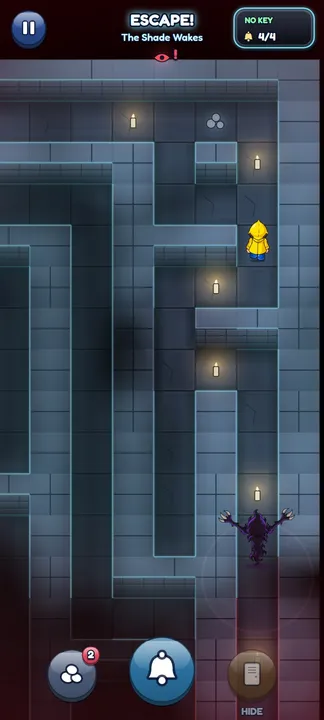
The 20th level of each area is a chase. The creature wakes, and the way out is marked by candles.
Stars are for silence
Stars in Silent Maze measure how quietly a maze was escaped. Each level has a quiet target, the number of rings allowed for three stars, starting at two in the very first maze. Up to two rings over the target still earns two stars, and any escape earns one. The counter in the corner turns red the moment the target is passed.
Every maze was also tested before release. A bot that routes around creatures, waits, throws pebbles and hides plays each level, and the maze for each level was picked so that the bot's win rate follows a planned difficulty curve.
On a keyboard, Space rings the bell, E hides, Q switches to aiming a pebble, and X stops the kid.