Rondo Guide: Timing the Perfect Pass

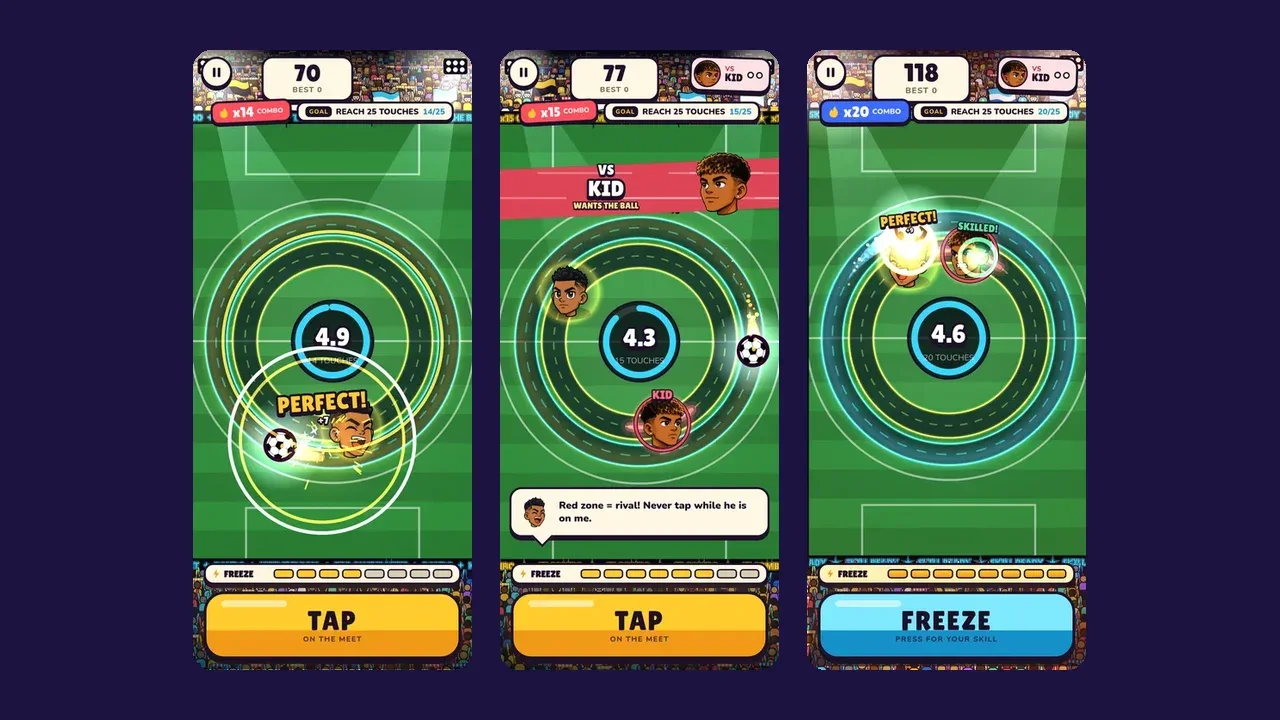
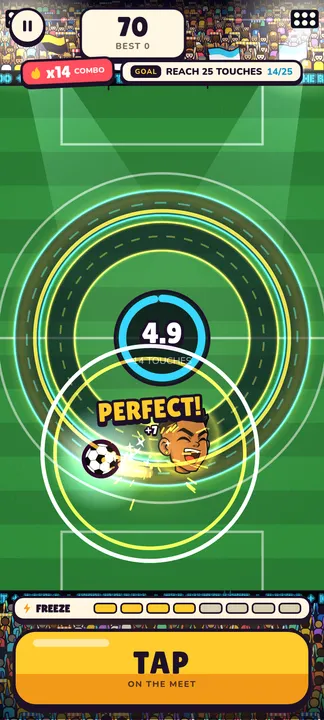
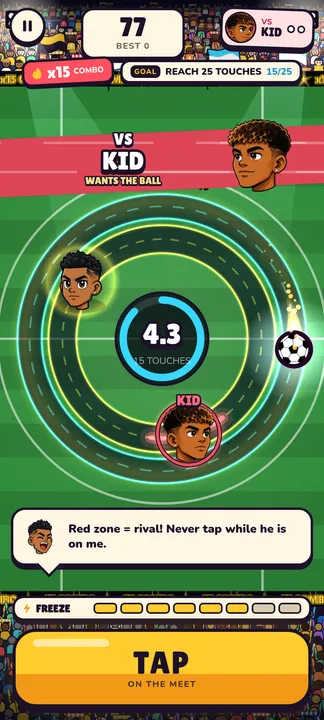
Rondo is built on two circles moving in opposite directions. The ball travels around the outer ring, the player's head travels around the inner ring the other way, and a tap at the moment they meet keeps the ball in play. Everything else in the game, the defenders, the decoys, the shot clock and the skills, is added on top of that one meeting point.
How a touch is graded
Rondo grades every tap by how far it was from the exact meeting, in milliseconds, so the window means the same thing at every speed.
| Grade | At start | After 30 | Points |
|---|---|---|---|
| Perfect | ±58 ms | ±46 ms | 3 |
| Good | ±125 ms | ±100 ms | 1 |
| Early or late | ±205 ms | ±172 ms | 1 |
The windows narrow from the first column to the second over a match's first 30 touches. A tap outside every band is a miss. It never ends the run, but it locks the input for 400 milliseconds, long enough to cost the next meeting. Each tap is also judged as if it had landed 40 ms earlier than the event arrived, to make up for the delay between a finger touching the glass and the game hearing about it.
Points grow with the combo. Every touch in an unbroken chain adds 10% to the multiplier, up to triple at a 20-touch combo, so a perfect at full combo is worth 9.
The ladder
The ball starts at 88 degrees a second and speeds up by 3% with each step, up to 240. New elements arrive at fixed touch counts, and the ball eases to 88% of its speed for eight touches whenever one does, so there is a moment to adjust.
| Touch | What arrives |
|---|---|
| 15 | A defender |
| 25 | A second teammate |
| 40 | Gold coins near the ring |
| 70 | A second defender |
| 90 | A decoy ball |
| 110 | A middle lane |
| 125 | Random mixes of everything |
The rules for each come from the game's own tips. A red zone means a defender is on the player, and a tap then gives the ball away. The first steal costs the combo, the flair and some shot clock; the second ends the run. With a second teammate, either player can take the ball. The orange ball from touch 90 is a fake, and the white one is the ball that counts. A gold ball means the next touch flips both lanes, which happens on 55% of successful touches and is always shown one touch ahead.
The shot clock starts at six seconds and shrinks to 3.2 as the match goes on. At zero, the ball is lost.
Flair and the six skills
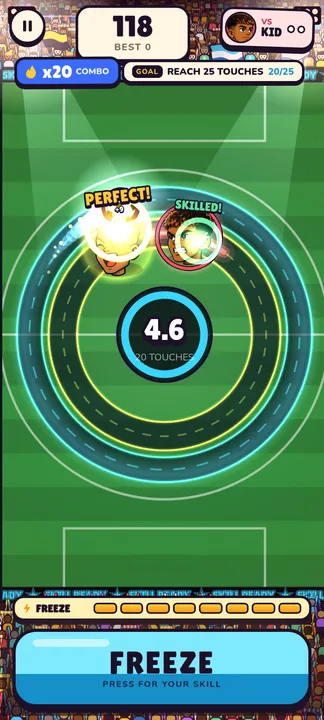
Every grade feeds an eight-segment flair meter: two segments for a perfect, one for a good, nothing for an early or late touch, and two taken away for a miss. A full meter fires the character's skill.
| Character | Skill | What it does | Price |
|---|---|---|---|
| Bolt | Freeze | Stops both rings for 1.5 s, for a free perfect | free |
| Turbo | Burst | Double points for 5 touches | 300 |
| Wizard | Magic Touch | Triple-width window for 3 touches | 650 |
| Kid | Bullet Time | Rings at 40% speed for 3 touches | 1,100 |
| Tower | Wall | No steals for 4 touches | 1,700 |
| Viking | Thunder | Every touch perfect for 3 touches | 2,600 |
Prices are in the coins collected during matches by touching the ball near a coin. Tower's Wall is the most useful from touch 70 on, when two defenders share the ring, and Viking's Thunder can carry a long combo through a hard stretch.
Ranks
Ranks count every touch across every match, so they only ever go up: Trialist at the start, Squad Player at 50, First Team at 200, Playmaker at 600, Captain at 1,500 and Legend at 3,500.
On a computer, Space or Enter plays the ball, and Enter fires the skill when the meter is full.