Maze Games: From Paper Puzzles to Glowing Corridors

The hedge maze at Hampton Court Palace was planted between 1689 and 1695 for King William III, and it is still the oldest surviving hedge maze in Britain. It covers about a third of an acre. Nearly three hundred years later, in 1973, three high school students on a work-study programme at NASA's Ames Research Center built a game called Maze on Imlac PDS-1 minicomputers. Players moved through a maze seen in first person and hunted each other, and it is believed to be the first 3D first-person game ever made.
Between those two dates, mazes moved from gardens onto paper, and from paper into games. A maze on a screen has one advantage over a hedge: it can be built fresh, by a program, every time.
How a computer builds a maze
The most common method is a randomised depth-first search, better known as the recursive backtracker. It starts in one cell, carves a passage to a random unvisited neighbour, and keeps going until it hits a dead end, then backs up to the last cell with an unvisited neighbour and carries on. When it finishes, every cell is connected and there is exactly one route between any two points. Mazes with that property are often called perfect mazes.
Wikipedia's article on maze generation describes what that method produces: mazes with "a low branching factor" and "many long corridors", because the algorithm explores as far as it can along each branch before turning back. That makes them good for walking and poor for escaping. With only one path between any two points, every dead end is a trap.
Braiding: putting loops back in
A game that involves being chased needs loops. The usual fix is called braiding: after the perfect maze is carved, some dead ends get one wall knocked out, which joins them to a neighbouring corridor and creates a loop.
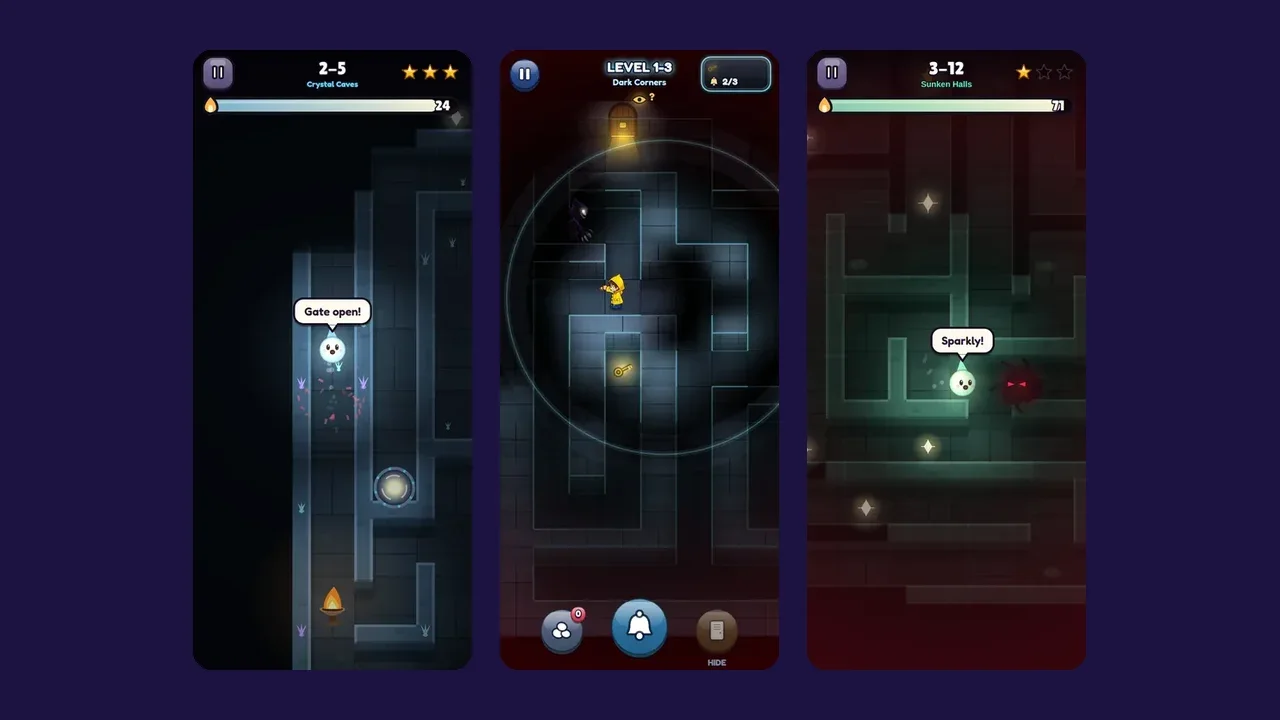
The two maze games on SalutGames both do this, and they tune it very differently.
| Lost Corridors | Silent Maze | |
|---|---|---|
| Carving | Seeded maze, exit far from the start | Recursive backtracker |
| Dead ends opened | about 1 in 5 | roughly 2 in 5 to 3 in 4 |
| Chase mazes | about 17 in 20 opened | the 20th level of each area |
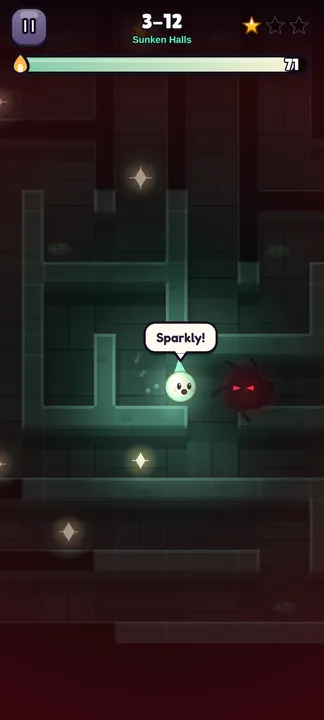
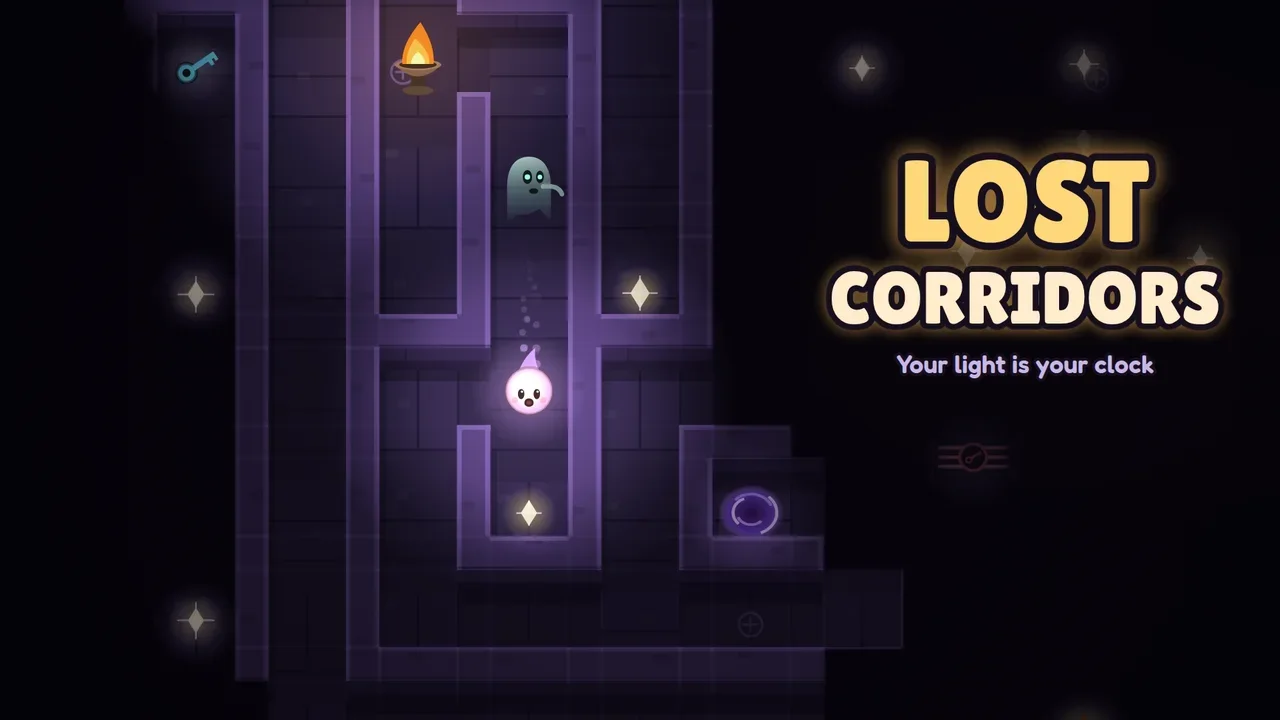
Lost Corridors keeps most of its dead ends, because they are part of the puzzle. Its star gems hide in them, and the exit itself sits at the end of a dead end, so Lumi can never glide straight through it by accident. Then, in the twelfth maze of every world, the chase, it opens about 85% of the dead ends. A maze that rewarded exploring now punishes it, and the loops are what make running possible.
Silent Maze braids its mazes much more from the start, because something is hunting the player in almost every level. A creature that can only be escaped by turning around in a dead end is a creature that can't be escaped at all. Loops give the kid a way to circle round, and small rooms break up the corridors.
Seeds: the same maze for everyone
Both games generate their mazes from a seed, a number that makes the random choices repeatable. Each level in Silent Maze has its own seed, chosen after a bot played candidate mazes so that its win rate follows the planned difficulty curve. That's why level 2-5 is the same maze on every phone, even though no one drew it by hand.
What a maze game asks for
A maze in a game is rarely about finding the exit alone. Lost Corridors turns it into a budget problem, with light draining every second. Silent Maze turns it into a sound problem, where the act of looking around gives the player away. The hedge at Hampton Court asks only for patience. Its descendants ask for planning, and the loops in their corridors are where that planning happens.
Sources
- Hampton Court Maze, Wikipedia
- Maze War, Wikipedia
- Maze generation algorithm, Wikipedia
- SalutGames: the maze generators of Lost Corridors and Silent Maze