Gravity Games: How Flipping Gravity Became a Puzzle Genre

In 1946 the Swedish toy company BRIO released Labyrinth, a box with a maze on top, holes along the way and a steel marble. Two knobs tilt the board, and the whole game is persuading gravity to roll the marble past every hole to the end. It has no screen, but it is an early ancestor of a puzzle idea that video games have returned to again and again: the player doesn't move the piece, the player moves the direction that "down" points.
Two ways to bend gravity
Gravity puzzles in games tend to fall into one of two families.
Flip the character. The world stays still and the character's personal gravity reverses, so the ceiling becomes a floor. The best-known example is VVVVVV, released by Terry Cavanagh on 11 January 2010, in which the player cannot jump at all and flips gravity instead. Wikipedia traces the mechanic further back, to an 8-bit game called Terminus from 1986.
Turn the world. The character stays subject to the same gravity, but the whole level rotates around it. And Yet It Moves, from the Vienna studio Broken Rules, did this on PC in 2009, rotating the world in steps of 90 or 180 degrees so that walls became floors. It began in 2007 as a bachelor project by four students at the Vienna University of Technology. Labyrinth is the physical version of the same family: tilt the world, and everything in it follows.
The same two families on SalutGames
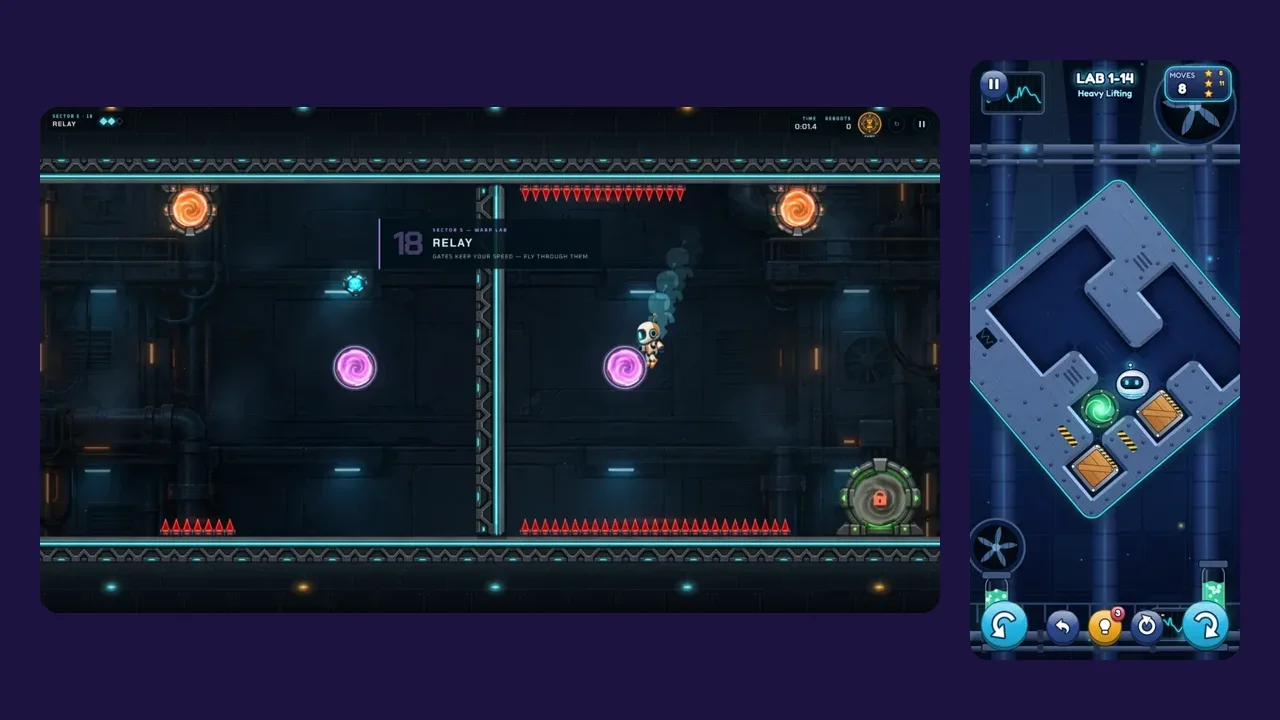
Each family has its own game on the site, and the difference shows up in almost every number.
| Gravibot | Gravity Lab | |
|---|---|---|
| Family | flip the character | turn the world |
| Directions of down | 2 | 4 |
| What falls | the robot, and crates | Orbi and every crate |
| Pace | real time | one move at a time |
| Par measured in | seconds | turns |
| Levels | 28 rooms | 60 labs |
| Total par | 403 s | 553 turns |
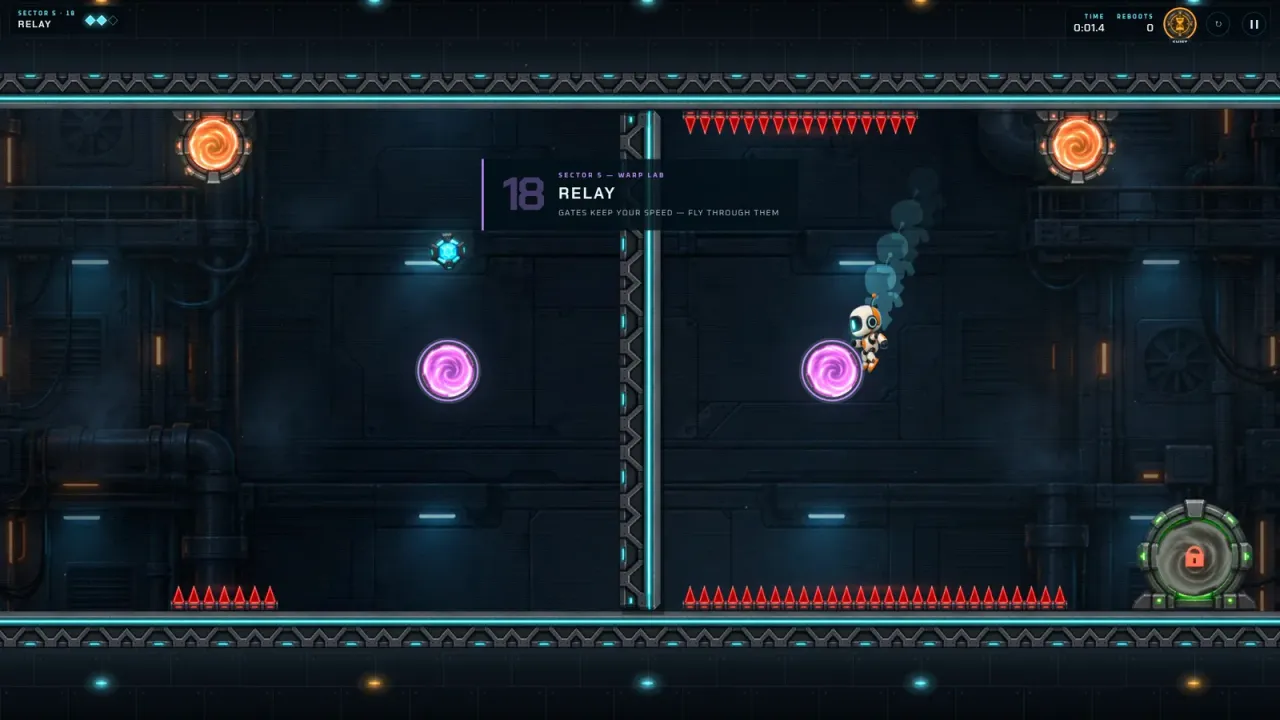
Gravibot is a real-time platformer. The robot walks and flips between floor and ceiling, and timing matters: a flip still works for 85 milliseconds after walking off an edge, and a flip pressed up to 130 milliseconds before landing is remembered. Later sectors add flip orbs that allow a flip in mid-air, the one moment the rule about standing on something is broken. Its par times come from a solver that plays every room, doubled and padded for humans.
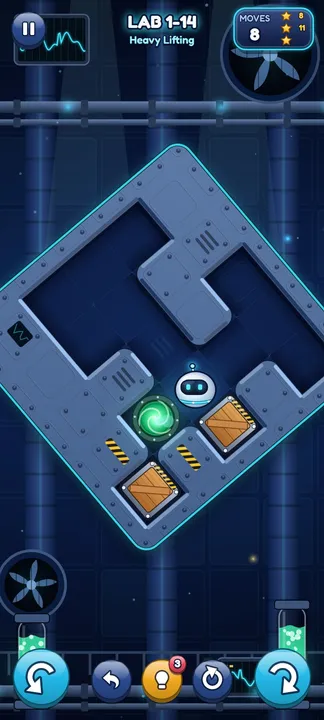
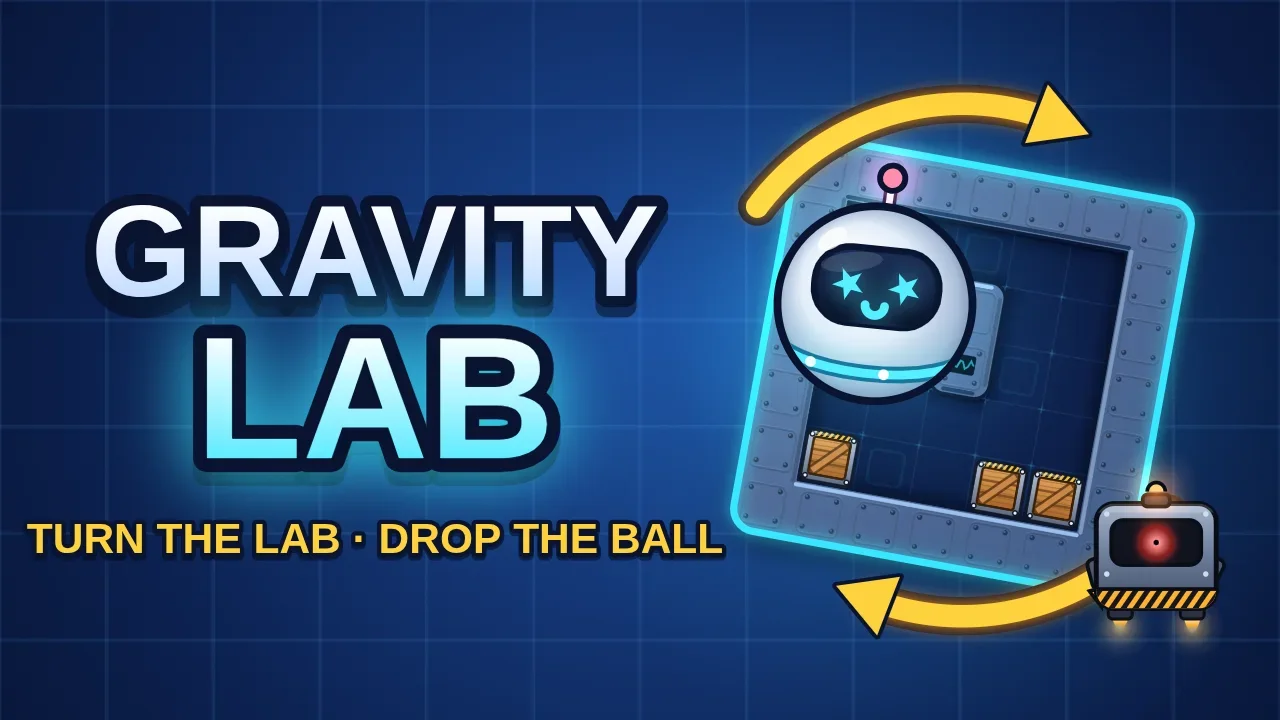
Gravity Lab is a turn-based puzzle. Each move rotates the lab 90 degrees, and then everything falls until it stops. Nothing depends on reflexes, and that changes what the puzzle is about: the challenge is in what the crates do, since every turn meant for Orbi moves them too. Its par is the smallest possible number of turns, found by a solver that searches every sequence.
Why gravity makes a good puzzle
Gravity puzzles share a quality that suits short sessions well: the rule is understood in a second, and it never changes. Everyone already knows that things fall down. The puzzle comes entirely from where "down" happens to be, and what else is lying around when it changes.
That is also why both families keep adding objects rather than new rules. Gravibot's later sectors add lifts, boost pads, conveyors, warp gates and flip orbs. Gravity Lab adds glass, portals, pressure plates and lasers. Each one is a new way for the same single rule to surprise the player.
Sources
- Labyrinth (marble game), Wikipedia
- VVVVVV, Wikipedia
- And Yet It Moves, Wikipedia
- SalutGames: the source code of Gravibot and Gravity Lab