Browser Games in 2026: Why Instant Play Makes Sense Again

Browser games had a long first life on desktop computers, and then phones and app stores took over most casual play. In 2026 several separate changes point back toward the browser at once. None of them is dramatic on its own. Together they make a strong case for games that open in a tab.
Play happens in short gaps
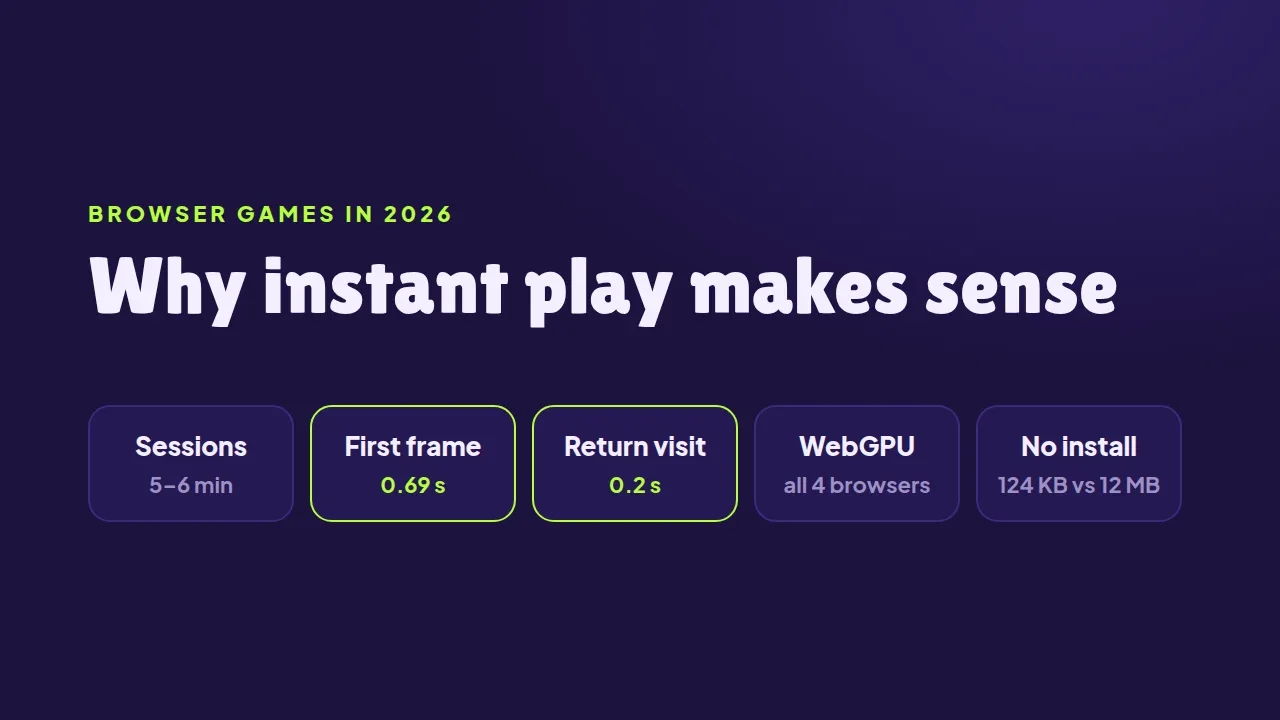
The analytics company GameAnalytics, drawing on 11,600 mobile games, puts the median play session at 5 to 6 minutes, with players opening a game about four times a day. That is play in short gaps, and in a five-minute gap the cost of getting started matters more than almost anything else.
An app has to be found, downloaded and installed before the first round. A browser game has to be opened. In tests of the SalutGames games in October 2026, the median game put its first frame on screen 0.69 seconds after its address was requested, and on a return visit 0.2 seconds, with about a kilobyte downloaded.
The browser caught up
The technical gap between browser games and installed ones has largely closed. WebAssembly, which runs code compiled from other languages at near-native speed, became an official web standard in December 2019. WebGPU, which gives a page modern access to the graphics card, reached the last of the four major browsers in 2025, and in November of that year web.dev announced it was supported across Chrome, Edge, Firefox and Safari.
That doesn't mean every browser game needs those tools. All thirteen SalutGames games use plain Canvas 2D, which is part of why they're small. What it means is that the ceiling has risen: a browser game is no longer limited to what was possible ten years ago.
The browser is the one thing every device has
Gaming on some devices has also narrowed toward the browser. On Chromebooks, the beta that allowed Steam to run ended on 1 January 2026, with Google pointing owners to Play Store apps, Linux and cloud streaming instead. Of all those routes, only the browser asks for nothing: no store, no Linux, no fast connection and no particular hardware.
The same game also reaches every kind of device without a separate version. The SalutGames games run on phones, tablets, Chromebooks and computers from the same files, with touch, mouse, keyboard and, in two of them, a gamepad.
Smaller than an app
Five SalutGames games exist both in the browser and as Android apps built from the same code. The comparison is stark. Dot Box Duel downloads 124 KB in the browser and its Android release build is about 12 MB. Skyhook is about 1 MB in the browser against 5.5 MB as an app. An app has to carry its own way of running the game, plus the services every app needs. A browser game relies on the browser that's already there.
What still favours apps
The case isn't one-sided. An installed app works offline once it's downloaded, keeps an icon on the home screen and can use some phone features directly. Browser saves also live in that one browser, and some settings, such as Safari's seven-day rule for sites that go unused or a school Chromebook that wipes data at sign-out, can erase them.
For a game played every day, on the same phone, often without signal, an app still has advantages. For a game played in a five-minute gap, on whatever device is at hand, the browser has rarely been a better fit than it is in 2026.

Sources
- Game Dev Reports, GameAnalytics: Mobile gaming benchmarks in 2025, 17 February 2025
- web.dev, WebGPU is now supported in major browsers, 25 November 2025
- W3C, WebAssembly becomes a W3C Recommendation, 5 December 2019
- PCWorld, Support for the Steam gaming platform is cancelled on Chromebooks, 8 August 2025
- SalutGames: load tests of the live games in October 2026, and the Android release builds of five games