
Spider Maze contains 150 handcrafted levels. The aim is not simply to make each web larger. New puzzles combine route shape, timing, move economy, special silk, collectibles, and additional threats in different ways.

Early levels teach a readable language
The first puzzles establish the essentials: glowing nodes are possible moves, connected strands form routes, the bright opening is the exit, and the spider creates urgency. Small webs make cause and effect easy to see.
Larger webs create meaningful choices
As the web expands, more branches become available. Difficulty comes from comparing those branches and recognizing which apparently short path leads to danger. Good maze design creates uncertainty while still giving the player enough information to reason.
Special silk changes familiar routes
Sticky purple and fragile orange strands make an old-looking connection behave differently. Players must account for timing and commitment, not just distance. Our silk guide explains both types.
Stars reward cleaner solutions
Escaping proves that a route works. Collecting dew drops and finishing with moves to spare asks whether it works efficiently. This makes a solved level worth replaying without changing its fundamental rules.
More spiders, more pressure
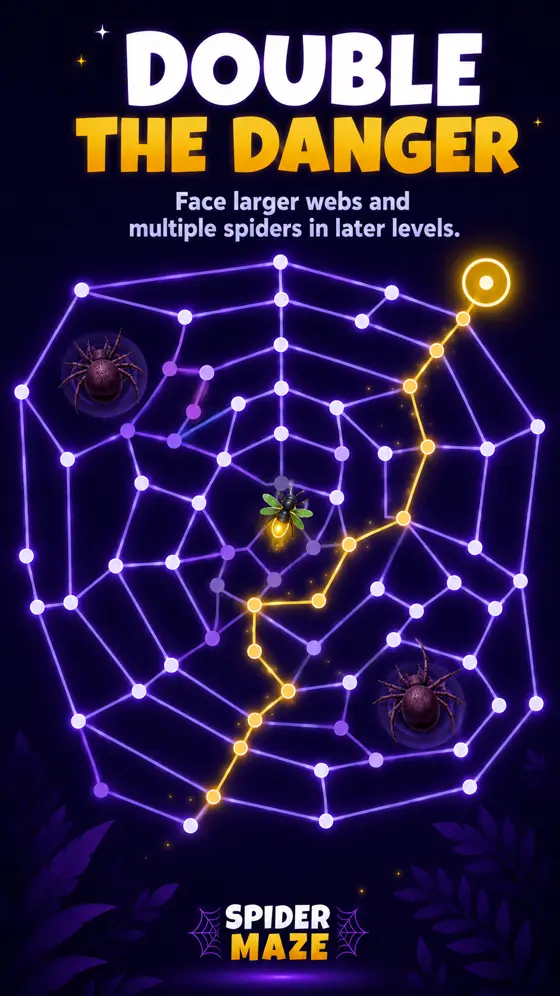
Later challenges introduce larger webs and multiple spiders. A route safe from one direction may be exposed from another, so planning requires a wider view. This is where a well-timed Freeze, Cut, or Undo can be decisive.
A puzzle built for short sessions
Each maze can be understood in a glance and explored in a few deliberate moves. That makes Spider Maze suitable for a quick break, while the star goals and growing complexity give strategy-minded players reasons to return.
Start playing with the beginner’s guide, then improve difficult escapes with our strategy tips.